How to Design a Small Bathroom: Space-Saving Ideas
Bathrooms
A small bathroom isn’t a problem to solve, it’s a layout to get right. Get it wrong and you’ve got a cramped room you brace yourself for every morning. Get it right and a 3 square metre box can work as hard as a room twice the size. The trick is the same one the trade uses on every tight job: lift things off the floor, keep the lines clean, and make every fitting earn its space. None of that needs a big budget, just the right kit.
This guide walks through what actually works in a small bathroom, fitting by fitting: the vanity, the basin, the toilet, the shower, the mirror and the storage. Real products, real sizes, and where each one falls down. There’s a shortlist at the end if you just want the picks.
- Small bathroom layout: the rules worth following
- Space-saving vanity units
- Compact basins for tight spaces
- Toilets that save the most space
- Showers and enclosures for small bathrooms
- Mirrors and storage that pull double duty
- Colour, tile and lighting tricks
- The small-bathroom shortlist
- FAQ
Small Bathroom Layout: The Rules Worth Following
Before you buy a single fitting, work out what the room can hold. UK building regs set minimum clearances around sanitaryware: roughly 200mm of clear space either side of a toilet and 600mm in front of it to actually use it. Squeeze below that on a renovation and building control won’t sign it off. Measure the room properly, in millimetres, and mark where the soil pipe and waste runs already sit before you fall in love with anything.
Three layout moves do most of the heavy lifting in a small room:
- Put the toilet behind the door swing. The first thing you see walking in shouldn’t be the loo. Sit it on the wall the door opens against, so the basin or shower is what greets you. The room reads tidier instantly, and it costs nothing to plan in.
- Keep the plumbing on one or two walls. Get the basin, toilet and shower onto the same wall, or two adjacent ones, and the waste runs stay short, the floor isn’t carved up by pipework, and the room feels more open. Spreading fittings across all four walls makes a tight room feel chaotic.
- Sort the door swing. An inward-opening door eats around 700mm of floor in its arc. In a 1.5m by 2m cloakroom that’s a third of the floor gone the second you open it. A sliding door, a pocket door that disappears into the wall cavity, or an outward-opening door if the landing allows, claws all of that back. It’s the single biggest space saving most people never think about.
The thread running through everything below is the same: get fittings off the floor wherever you can. A wall-hung vanity, a wall-hung toilet, a floating shelf. The more continuous floor you can see, the bigger the room feels, and the easier it is to mop under. That’s why so many of the picks here are wall-mounted. If you want to weigh up the trade-offs in full, our guide to wall-hung versus floor-standing bathroom furniture goes deeper on fixing and load.
Space-Saving Vanity Units
The vanity is where a small bathroom is won or lost, because it’s the one fitting that can give you storage and a basin and a clean visual line all at once. The rule is simple: go wall-hung, and go no wider than you need. A unit that floats off the floor shows the skirting and tiles running underneath, and that strip of visible floor is what tricks the eye into reading the room as larger.
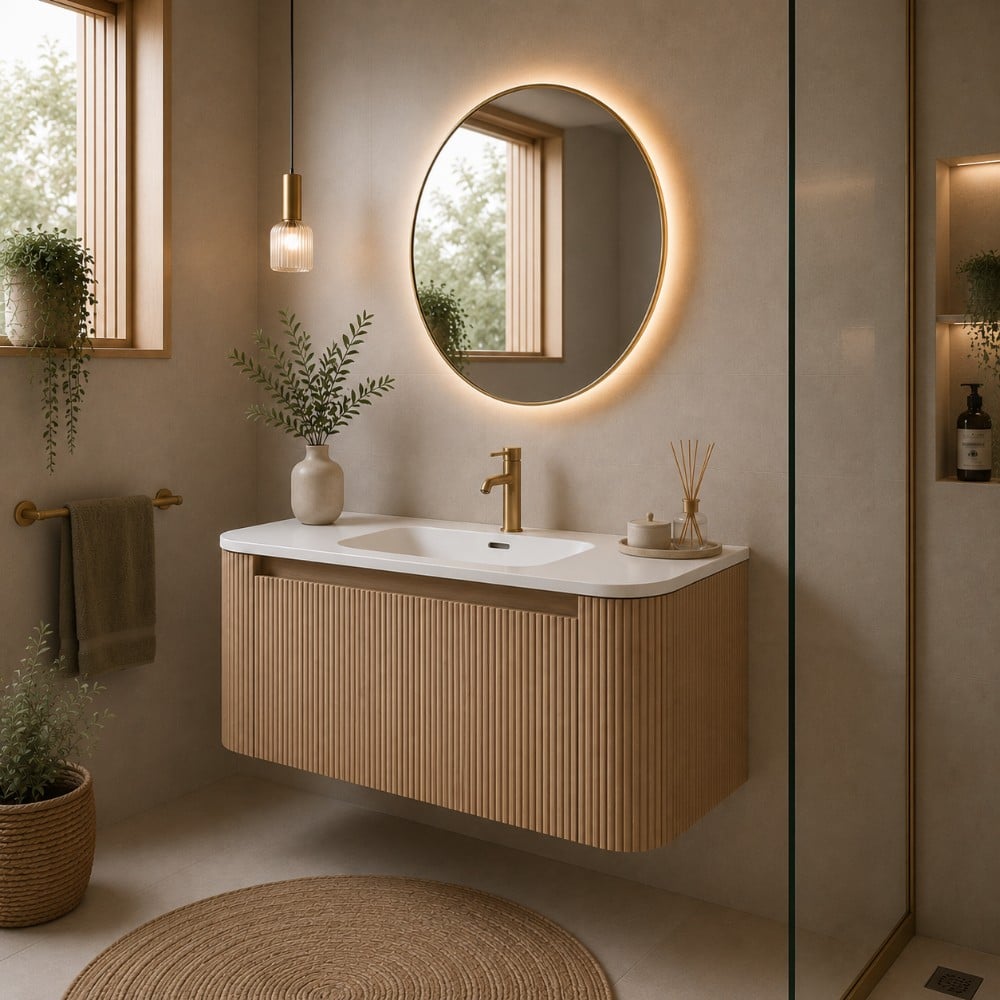
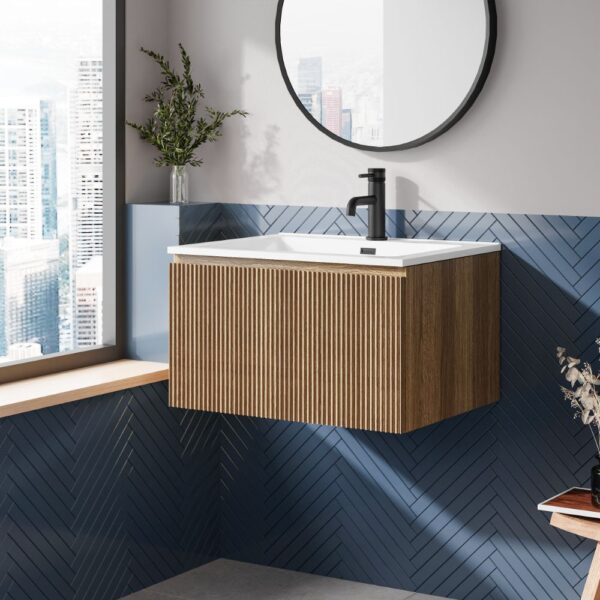
My first pick for most small bathrooms is the Alfie 600mm Fluted Sonoma Oak Wall Hung Vanity Unit and Basin at £399. It’s one of our fluted vanity units, and that ribbed front adds texture and depth without making a small room feel busy. It’s a wall-hung design, so it lifts everything off the floor and opens the room up, and the fluted wood front in a warm Sonoma oak finish stops it looking like a sterile box. You get hidden internal storage for the clutter that otherwise lives on the windowsill, and at 600mm it still suits a genuinely small bathroom or en-suite. If you’ve only got 600mm of usable wall, this is the one I’d start with.
Tighter than that, or watching the budget, drop to 500mm. The Scudo Bella 500mm Two Drawer Unit and Basin in Gloss White is £299 and packs two soft-close drawers with a handleless recessed design into a 500mm wall-mounted footprint. The handleless front matters in a small room: nothing sticks out to catch your hip or clutter the line. The bright gloss white bounces light around, which is exactly what you want when the room is short on it, and the integrated ceramic basin comes with a single pre-drilled tap hole ready to go. It’s pitched at en-suites and cloakrooms of all sizes, and it earns that.
If your small bathroom still wants a bit of personality, you don’t have to settle for white-box minimalism. The Linea Curve 600mm Wall Mounted Vanity Unit and Stone Cast Basin in Reed Green at £479 is the one to spend a little more on. You get a curved, fluted front in a calming reed green, an integrated stone resin basin that feels a cut above a standard ceramic top, and a single soft-close drawer with an integrated recessed handle. It’s built from moisture-resistant MFC and MDF, so it copes with bathroom humidity. The curved front also softens the corner of the room, which is a quiet win in a space full of hard edges.
One thing the brochure won’t shout about: a wall-hung vanity is only as good as the wall behind it. These units carry the basin, the water and your weight leaning on them, so they need a solid masonry wall or a properly braced stud wall, not a single sheet of plasterboard with a couple of screws. If your wall is hollow, get it braced before you hang anything. A unit on the floor an hour later is not the look.
Compact Basins for Tight Spaces
Sometimes a full vanity is too much furniture for the room, and a slim basin on its own is the smarter call. This is the usual answer in a downstairs cloakroom, or a second bathroom where you just need somewhere to wash your hands without losing half the floor to a cupboard.
For flexibility, the Litchfield Luna 500mm Basin at £99 is a sensible default. It measures 507mm wide by 355mm deep by 127mm high, so it’s compact enough for a cloakroom or a smaller bathroom, and it’s made from high-quality gloss white ceramic with a single tap hole and a built-in overflow. The clever part is that it can be wall-mounted or sat on a countertop or slim unit, so you can decide how to fit it once you’ve seen how the room shapes up. If you change your mind about the layout mid-project, this basin doesn’t tie your hands.
When every centimetre genuinely counts, go smaller again with the Litchfield Orbit 450mm Wall-Hung Compact Basin at £79.99. At 450mm wide with a shallow 220mm projection and a 120mm height, it’s the tightest-fit pick here, and that shallow projection is the bit that matters: it barely intrudes into the room. It’s made from premium vitreous china in a gloss-white finish, and being wall-hung it frees up the floor underneath in a cloakroom or small bathroom. It’s the basin for the awkward corner under the stairs where nothing else fits. You’ll find it and its siblings in our basins range.
Whichever you choose, pair a compact basin with a single-lever mono tap rather than separate hot and cold pillar taps. One tap takes up less of the basin, leaves more usable bowl, and looks cleaner. If you want a hand choosing one, our sink tap buying guide runs through the options.
Toilets That Save the Most Space
The toilet is the bulkiest single fitting in most small bathrooms, so where you can claw back depth, you should. There are three ways to fit one, and they save very different amounts of space, so it’s worth understanding the trade-offs before you pick. Our full guide to choosing a toilet covers the detail, but here’s how the three types stack up for a small room.
Wall-hung: the maximum floor-space option
A wall-hung pan bolts to a frame in the wall and leaves the floor completely clear underneath. That clear floor is the single most effective visual trick in a small bathroom, and it makes mopping around the loo genuinely easy instead of a fiddle. The Belini Rimless Wall Hung Pan at £179 is the one I’d reach for: it’s 360mm wide, 300mm high and 495mm deep, made from high-quality vitreous china, rimless for easy cleaning, and it creates that floating effect that adds a real sense of space. The one catch, and it’s an important one, is that a wall-hung pan needs a concealed support frame and an in-wall cistern behind it (sold separately). That frame eats wall depth and adds to the cost, so it’s the right call when you’re already building out a stud wall or boxing in the plumbing, not when you want a quick swap.
Back-to-wall: tidy lines without the frame headache
If you want most of the wall-hung look without committing to an in-wall frame, a back-to-wall pan is the middle ground. It sits on the floor but pushes flush against the wall, with the cistern hidden inside a WC unit or behind a stud wall, so there’s no exposed cistern breaking up the room. The Deia Comfort Height Rimless Back-to-Wall Toilet Pan at £199 does exactly this: the back-to-wall construction conceals the plumbing and fittings for a smooth, minimalist look, the rimless bowl has no hidden ledges to scrub, and it comes with a soft-close, quick-release seat. The comfort-height design also reduces strain on the knees, which is worth knowing if anyone in the house finds a low pan hard work.
Close-coupled: the simple, affordable fallback
No room for a concealed frame and no appetite for boxing in a cistern? A close-coupled toilet still fits against any standard wall and installs in an afternoon. The Litchfield Nova Close Coupled Toilet at £129 has clean lines and a compact design, sturdy vitreous china, and a dual flush cistern (3 litres or 6 litres) that keeps your water bill down. It’s the honest choice when the others are overkill for the job, and the water-saving flush is a nice bonus.
My rule of thumb: building out a stud wall anyway, go wall-hung; want the tidy look with less hassle, go back-to-wall; tight budget or a straight swap, the close-coupled Nova does the job without fuss.
Showers and Enclosures for Small Bathrooms
In a small bathroom, the question is rarely bath versus shower, it’s how to fit a shower that doesn’t dominate. The honest answer for most tight rooms is to drop the bath entirely. Pulling out a bath gives you back roughly 1.6 square metres of usable floor, which is transformative in a room this size. Keep the bath only if you genuinely use it, for small children or mobility reasons. If it’s been sitting there getting used twice a year, it’s costing you the best part of the room.
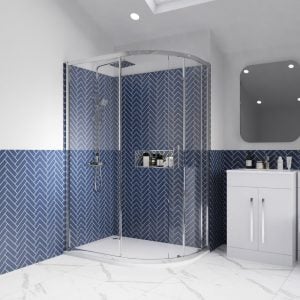
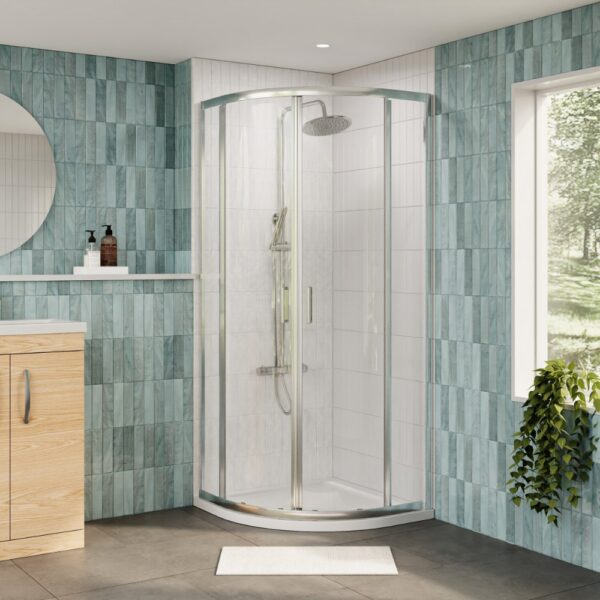
With the bath gone, the enclosure that works hardest in a corner is a quadrant. The curved front takes up less floor than a square enclosure of the same internal size, and a quadrant with sliding doors needs zero clearance to open into the room, which is the whole game in a tight space. My pick is the Litchfield i6 Matt Black Quadrant Shower Enclosure 800mm at £209. The space-saving quadrant design tucks neatly into the corner, the smooth sliding double doors let you in without needing any swing clearance, and it’s built from 6mm toughened glass in a bold matt black frame that looks far more expensive than the price suggests. It also comes with a lifetime guarantee. 800 by 800 is the smallest size I’d recommend for a shower you’ll actually enjoy standing in; go below that and it starts to feel like a phone box.

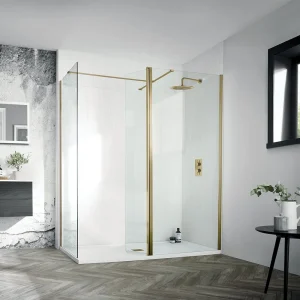
If even a quadrant is too much, and you’re renovating a small en-suite from scratch, a walk-in setup with a single fixed glass panel and no door gives the most open feel of all. It needs a properly tanked, sloped floor to drain, so it’s a bigger job, but in the smallest rooms it can be the best use of space. Our guide to wet rooms and walk-in showers covers whether it’s right for your room, and if you’re weighing up door styles, choosing the perfect shower doors compares sliding, bifold and hinged options for tight spaces.
Mirrors and Storage That Pull Double Duty
Storage in a small bathroom has to go vertical, because horizontal surfaces are exactly what you don’t have. The smartest fittings here do two jobs at once, so you’re not spending wall space twice.
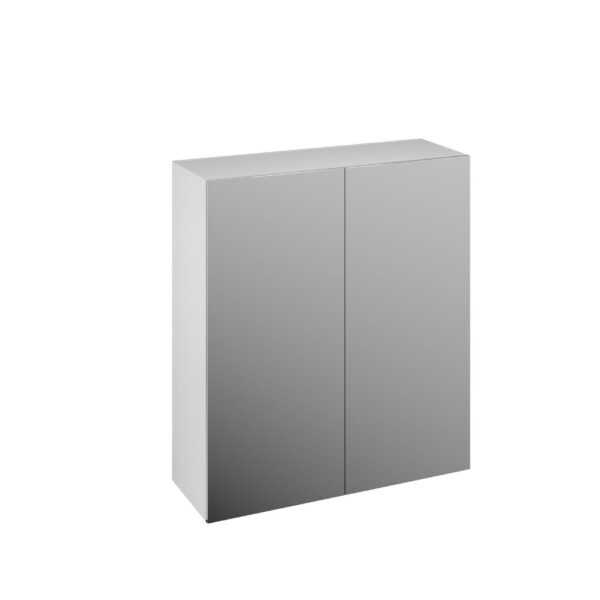
The standout is a mirror cabinet, because it bounces light around to make the room feel bigger and hides your clutter behind the glass, recovering the wall space a separate cabinet would have eaten. The LED Mirror Cabinet 500 x 700mm at £259 is the one I’d fit above the basin, where you want a mirror anyway. It has infrared sensor LED lighting for touch-free switching, a built-in demister pad so it stays clear after a hot shower, and an integrated shaver socket. Inside there are two adjustable glass shelves and a soft-close door, the mirrored side panels widen what you can see, and it’s IP44-rated for bathroom use. That’s a mirror, a light, a cabinet and a demister in one fitting that takes up no floor at all.
A couple of other vertical wins worth planning in:
- Use the wall above the cistern. The space above a toilet is almost always wasted. A wall cupboard or a slim open shelf there adds storage without touching the floor.
- Go tall and narrow, not wide. A 300mm-wide storage tower running up to ceiling height holds towels and bottles in a footprint you’ll barely notice in a corner.
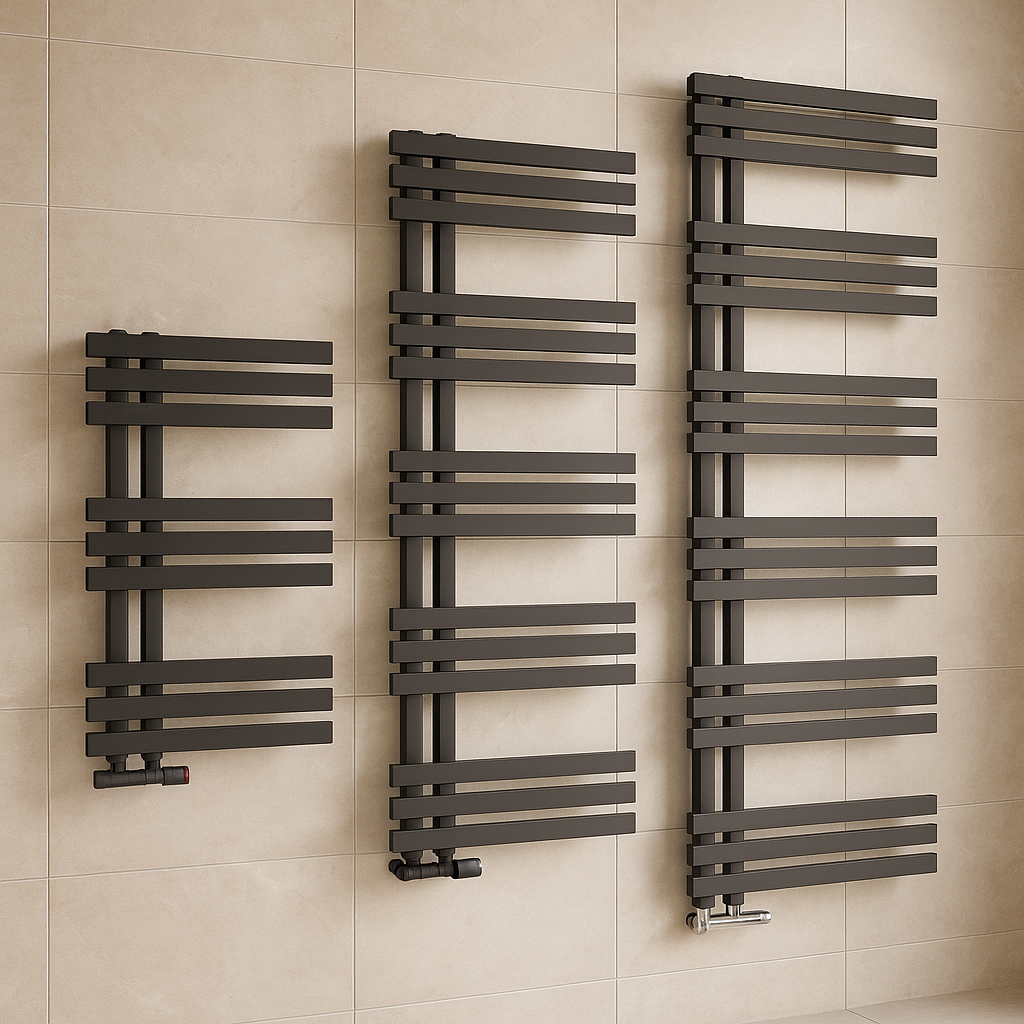
While we’re talking about surfaces earning their keep, your radiator can do storage too. A ladder-style towel rail uses only vertical wall space, warms the room and dries your towels in one go. The Strive Chrome Towel Radiator 600 x 800mm at £69 is sized for small and mid-sized bathrooms, its wall-mounted ladder design keeps the floor clear, it’s built from long-lasting steel, works with central heating, and carries a 5-year guarantee. Swapping a chunky horizontal radiator for one of these is an easy way to reclaim a stretch of wall.
Colour, Tile and Lighting Tricks
Once the fittings are sorted, a few finishing decisions make the room feel bigger without moving a single pipe.
Light, not stark white
An all-white bathroom can read clinical rather than spacious. A better bet is light walls with a slightly warm undertone, soft stone, very pale grey or warm off-white, with a darker floor to ground the room. The gentle contrast adds depth, and depth reads as space.
Big tiles, fewer grout lines
Large floor tiles, 600 by 600mm or bigger, make a small floor feel larger because there’s less visual clutter. Grout lines chop up the space, so fewer lines mean more apparent floor. The same logic works on the walls.
One feature wall, not four
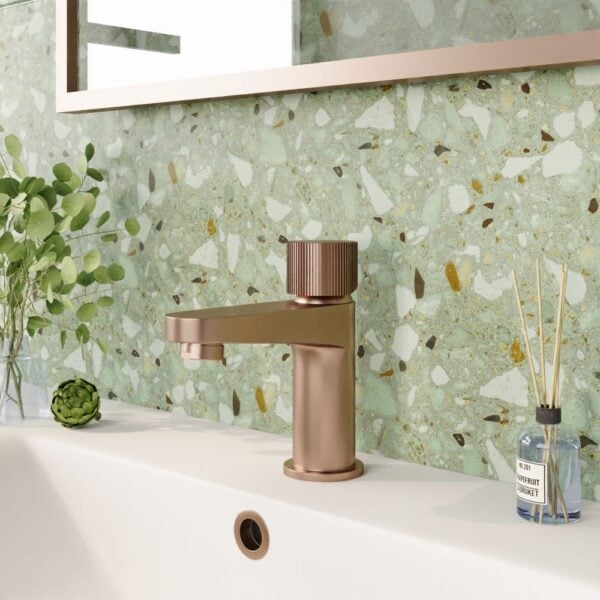
Want pattern or a bold colour? Put it on a single wall, usually the one behind the basin or the shower, and keep the other three plain. Pattern on every wall makes a small room feel busy and closes it in.
Layer the lighting
Aim for at least three light sources: a ceiling light for general brightness, a task light at the mirror (the LED cabinet above sorts that), and an accent light such as a recessed shower downlight or an under-cabinet LED strip. A single overhead bulb throws shadows and makes the room feel smaller than it is.
The Small-Bathroom Shortlist
If you skipped to the end, here’s the kit I’d spec for a small bathroom, by job:
| Job | Pick | Price | Why it works in a small room |
|---|---|---|---|
| Hero vanity | Alfie 600mm Fluted Oak Wall Hung Unit | £399 | Wall-hung, hidden storage, warm fluted finish |
| Budget vanity | Scudo Bella 500mm Two Drawer Unit | £299 | 500mm, two soft-close drawers, light-bouncing gloss white |
| Statement vanity | Linea Curve 600mm, Reed Green | £479 | Colour and a stone-cast basin without the bulk |
| Compact basin | Litchfield Luna 500mm | £99 | Wall-hung or countertop, 507mm wide |
| Tightest basin | Litchfield Orbit 450mm | £79.99 | 450mm wide, shallow 220mm projection |
| Toilet (max floor) | Belini Rimless Wall Hung Pan | £179 | Floating pan, clear floor (needs concealed frame) |
| Toilet (tidy, easy) | Deia Comfort Height Back-to-Wall | £199 | Hidden cistern, no in-wall frame needed |
| Toilet (simple) | Litchfield Nova Close Coupled | £129 | Fits any wall, 3/6L dual flush |
| Shower enclosure | Litchfield i6 Matt Black Quadrant 800mm | £209 | Corner curve, sliding doors, no swing clearance |
| Mirror and storage | LED Mirror Cabinet 500×700 | £259 | Mirror, light, demister and cabinet in one |
| Heating and towels | Strive Chrome Towel Radiator 600×800 | £69 | Vertical ladder rail, keeps the floor clear |
Prices are indicative, so treat them as a starting point rather than a fixed quote.
Frequently Asked Questions
How do I make a small bathroom look bigger?
Lift the fittings off the floor and bounce light around. Wall-hung sanitaryware and a wall-hung vanity show continuous floor, which tricks the eye into reading the room as larger. Add a big mirror above the basin, a gloss or light wall colour, large floor tiles with fewer grout lines, and layered lighting. The mirror and tile changes alone make a noticeable difference even before you touch the layout.
What’s the minimum size for a usable bathroom?
UK building regs allow a room as small as around 1.7 square metres (roughly 1.4m by 1.2m) for a toilet and basin only. For a toilet, basin and shower enclosure, you want at least 2.8 to 3 square metres. Squeeze in a bath as well and you’re looking at around 3.5 to 4 square metres before it starts to feel tight.
What size shower enclosure fits in a small bathroom?
An 800mm by 800mm quadrant is the smallest size I’d recommend for a shower you’ll actually enjoy using. The curved front and sliding doors mean it needs no clearance to open into the room. Below 800mm the enclosure starts to feel cramped, so if you’ve only got space for a 700mm square, look at a walk-in panel or a small wet room instead.
Is a wall-hung or back-to-wall toilet better for a small bathroom?
Wall-hung saves the most space because the floor stays clear underneath, but it needs a concealed support frame and in-wall cistern, which adds depth and cost. Back-to-wall gives you nearly the same tidy look by hiding the cistern in a unit or stud wall, without the in-wall frame. If you’re already building out a wall, go wall-hung; otherwise back-to-wall is the easier win.
Can I have a vanity unit in a tiny bathroom?
Yes, just keep it wall-hung and no wider than you need. A 500mm unit like the Scudo Bella, or a 600mm wall-hung Alfie, gives you a basin plus hidden storage without dominating the room. In a true cloakroom where even that’s too much, fit a compact wall-hung basin on its own instead.
What colour suits a small bathroom?
Pale, slightly warm shades work best: soft stone, very pale grey or a warm off-white. Pure brilliant white can feel clinical. If you want colour, put it on one feature wall or bring it in through a single statement fitting like a reed-green vanity, and keep the rest calm.
Ready to spec your room? Browse the bathroom furniture range, the toilets range and the mirrors range for small-bathroom-friendly options. If you’ve got exact dimensions to work with, send them over and we’ll help you pick the combination that fits.