Shower Doors & Bath Screens: Buying Guide
Showers
Shower doors look like a one-decision job. They aren’t. The mechanism (sliding, pivot, bifold, hinged or a fixed walk-in panel) decides whether the door clears your basin, how easily you get in, and how much faff the thing is to clean. The glass thickness decides whether it feels solid or rattles. The finish decides whether the room looks planned or thrown together. Get the mechanism right for your layout first, match the glass and finish second, and the rest falls into place.
This guide runs through every door and screen type with a real example so you can see the size, spec and money involved, then covers sizing, glass thickness, finishes, fitting and cleaning. There’s a quick comparison further down if you just want the short version.
- Shower door types: which suits your bathroom
- Quadrant and walk-in enclosures
- Bath shower screens
- Quick comparison: which door type
- Sizing, adjustment and glass thickness
- Chrome, matt black and brushed brass finishes
- Fitting and clearance
- Cleaning and maintenance
- FAQ
Shower Door Types: Which Suits Your Bathroom
There are four main door mechanisms for an alcove or corner shower: pivot, sliding, bifold and hinged. The right one is almost always decided by the gap you’ve got and how much room there is in front of the shower for a door to swing. Here’s each one with a real example so you can see what it costs and how it behaves.
Pivot doors (the budget all-rounder)
A pivot door turns on a single hinge point near the top and bottom, swinging open with the pivot set in slightly from the edge, so it takes less room out front than a fully hinged door. It’s the sensible default for a recess between two walls, and it’s usually the cheapest way into a proper glass enclosure.
The entry point is the Litchfield Glide Chrome Pivot Shower Door 700mm at £159. It’s 6mm toughened safety glass with classic pivot operation for effortless access, a polished chrome frame and a lifetime guarantee. The clever bit is the optional side panels: add one and you turn a single recess door into a full corner enclosure on a budget. The side panels come with proper fitting ranges (the 700mm side panel fits a 670mm to 690mm wall, for instance), so you can build the enclosure to the wall you’ve actually got rather than the one you wish you had. Browse the rest of the pivot shower door range if you need a wider size.
Best for: a recess/alcove shower on a budget, or a corner enclosure built from a door plus a side panel.
Sliding doors (for wide openings and no swing room)
A sliding door runs on a track and the panels glide past each other, so there’s no door swinging out into the room at all. That makes it the answer for a wide opening (1000mm and up) or any spot where furniture, a basin or the toilet sits too close for a hinged or pivot door to clear.
The pick here is the Litchfield i6 Matt Black 1000mm Sliding Shower Door at £159. The nominal width of 1000mm includes a flexible adjustment range from 950mm up to 990mm, which matters because real walls are never the size the tape measure says they should be. It runs on a smooth sliding action for everyday convenience and wears a durable, easy-clean matt black frame, so it suits a contemporary scheme and hides watermarks better than chrome. Optional side panels run from 700mm to 1000mm if you’re building a corner. For other widths, the sliding shower door range covers the lot.
Best for: wide openings, and any layout where a door can’t swing outward into the room.
Bifold doors (the small-bathroom saviour)
A bifold folds in on itself when you open it, the two glass panels hinging in the middle so the door folds back rather than swinging out. It’s the move for a tight bathroom or an awkward spot where there’s no room for a door to swing out and a sliding door doesn’t fit, because nothing projects into the room.
Look at the Litchfield i5 760mm Bifold Shower Door in Chrome at £209. It’s a reversible inward door that helps save space, in 5mm or 6mm toughened safety glass (confirm with supplier), standing 1850mm tall with a satin chrome finish and universal left or right opening. The i5 adjusts from 710mm to 750mm, so it slots into a tight recess with a bit of give. One honest note: the folded panels eat a little of the entrance width, so a bifold opening is narrower than a sliding or hinged door of the same nominal size. In a small en-suite that’s a fair trade for losing the swing entirely. There’s more in the bifold shower door range.
Best for: small bathrooms and en-suites with no clearance for an outward swing.
Hinged doors (the premium wide opening)
A hinged door swings open like a normal door, giving the widest, most generous opening of any type. It needs proper clearance in front of the shower, so it’s for bathrooms with room to spare, but when you’ve got the space it feels the most like walking into a room rather than squeezing into a box.
The Athena Hinged Shower Door in Chrome starts from £339 and is a configurable product: door sizes run 800mm, 900mm, 1000mm and 1200mm, with optional side panels at 700mm, 760mm, 800mm and 900mm. It’s toughened safety glass in a chrome finish and works as either a straight recess door or, with a side panel, a corner enclosure. Pick this when you’ve got generous clearance and want the shower to feel like the best bit of the bathroom. The wider hinged shower door range has the alternatives.
Best for: larger bathrooms with clear floor space in front of the shower, where you want a wide, premium-feel opening.
Quadrant and Walk-In Enclosures
Not every shower is a single door in a flat wall. Two other shapes solve specific problems: the quadrant for corners, and the walk-in panel for an open, doorless feel.
Quadrant enclosures (the corner space-saver)
A quadrant has a curved front and tucks into a corner, so it gives you a shower without a square enclosure jutting into the room. It comes as a complete unit (curved glass plus doors) rather than a single door you build onto, which makes it the tidy answer when the only spare spot is a corner.
The Litchfield Glide Chrome Double Door Quadrant Shower Enclosure 800mm at £189 is the one to look at. It’s 6mm toughened safety glass with double sliding doors for easy access, a space-saving quadrant design, and precision glide rollers for smooth door operation, in polished chrome with a lifetime guarantee. The double sliding doors are the key detail: because they slide rather than swing, you get the corner-saving curve and no door knocking into anything. It’s designed for standard shower trays, so pair it with an 800mm quadrant tray. The full quadrant enclosure range has other sizes.
Best for: corner installations where a curved front saves floor space and you want a complete door-plus-panels unit.
Walk-in panels (the open, doorless look)
A walk-in setup is a fixed glass panel (or two) with a wide open entrance and no door at all. It’s the cleanest, most open look going, it’s the easiest type to keep clean because there’s no door mechanism or track, and it works on a tiled wetroom floor or a low-profile tray. The catch is splash control: the entrance has to be open enough to walk through but contained enough that water stays in the shower.
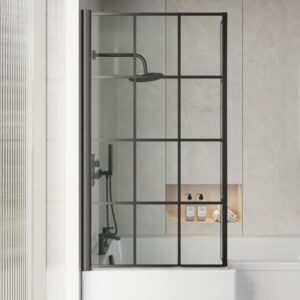
For a modern industrial look, the Scudo Black Framed 8mm Easy Clean 2 Panel Pack Walk In Glass Enclosure at £249 (700mm front panel) is a strong pick. The enclosure stands 1950mm tall in 8mm thick toughened safety glass, with 16mm thick silkscreen printed black inner grid lines for that crittall-style grid effect that’s everywhere right now. It comes with a 1 metre support arm, has Aqua Shield treatment to keep limescale at bay, and crucially gives you 10mm of adjustment in the wall channel for out-of-true walls, which old houses always have. There’s an optional hinged flipper panel if you want extra splash control. It fits a shower tray or a wetroom floor. If a walk-in is the direction you’re heading, our guide to whether a walk-in shower is right for your bathroom covers the wider decision.
For a single fixed screen in a warmer finish, the Litchfield 8mm Brushed Brass Wetroom Glass Panel with Hinged Flipper from £249 (the 700mm panel plus 275mm flipper) is the one. It’s 8mm toughened safety glass standing a tall 2000mm, with an integrated hinged flipper (a deflector panel) for splash control and an adjustable wall channel for flexible installation. The brushed brass finish suits a brass-coordinated scheme, and it also comes in chrome, matt black, gunmetal and brushed bronze if brass isn’t your thing. It fits wetroom floors or shower trays and carries a lifetime guarantee. The wider walk-in glass panel range has the other finishes and sizes.
Best for: wetroom floors and low-profile trays where you want an open feel; the flipper panel earns its keep on splash control.
Bath Shower Screens
If you’ve got a shower over the bath, a glass bath screen replaces the old shower curtain. It looks far better, wipes clean instead of going mouldy, and doesn’t cling to your legs. Two shapes cover most bathrooms: a fixed single panel for a minimalist look, and a pivot screen with a fixed panel for proper coverage.
Fixed single-panel screens (the minimalist choice)
A single fixed panel at the showering end of the bath is the cleanest, most uncluttered option. Nothing folds or hinges, so you step around it to get in. It suits adults who don’t need the bath end fully open and want the screen to all but disappear.
The Litchfield Thalia Brushed Brass Single Panel Bath Screen at £209 is the pick for a warm-metal scheme. It’s a sleek single panel design in 8mm toughened safety glass, fixed for a modern, open shower space, with an easy clean coating to reduce limescale and marks, in a brushed brass finish to match brass taps. That 8mm glass and the fixed design are what make it feel solid rather than wobbly. Have a look at the rest of the bath shower screen range for other finishes.
Best for: an over-bath shower where you want a minimalist, fixed screen rather than anything that folds.
Pivot bath screens (more coverage, easy access)
If a single fixed panel doesn’t give you enough splash protection, a pivot bath screen with a fixed panel does. You get a fixed section plus a large pivoting door, so the door swings out of the way for getting in and bathing, then closes for proper coverage while showering. It’s the better call for a family bathroom where someone’s bathing the kids one minute and showering the next.
The Matt Black 900mm Pivot Bath Screen Including Fixed Panel is £199. It’s 6mm toughened safety glass, 900mm wide and 1500mm tall, with a fixed panel plus a large pivot door, reversible installation so it works either handed, and top and bottom metal hinges (strong hardware, not the plastic you find on cheaper screens). The matt black finish suits a modern or industrial bathroom and hides watermarks well, which is half the battle on a screen you look at every day.
Best for: over-bath showers needing more coverage than a single fixed panel, where a wide pivot door plus fixed panel gives both splash protection and easy access.
Quick Comparison: Which Door Type
The short version. Match your situation to the left column and the recommendation falls out.
| Type | Best for | Swing room needed? | Example |
|---|---|---|---|
| Pivot door | Budget recess or corner enclosure | A little (less than hinged) | Litchfield Glide 700mm (£159) |
| Sliding door | Wide openings, no outward clearance | None | Litchfield i6 1000mm (£159) |
| Bifold door | Small bathrooms and en-suites | None (folds inward) | Litchfield i5 760mm (£209) |
| Hinged door | Larger rooms, premium wide opening | Plenty (full door width) | Athena Hinged (from £339) |
| Quadrant enclosure | Corners, complete unit | None (sliding doors) | Litchfield Glide Quadrant 800mm (£189) |
| Walk-in panel | Wetrooms, open doorless look | None (no door) | Scudo Black Framed 2-panel (£249) |
One thing to take away: if floor space in front of the shower is tight, you want a sliding door, a bifold, a quadrant or a walk-in. Save the hinged and pivot doors for where there’s room to open them properly.
Sizing, Adjustment and Glass Thickness
Two numbers decide whether a door fits: the opening width and the adjustment range. Walls are never perfectly plumb or exactly the size you measured, which is why decent doors are built with an adjustment range rather than a single fixed width.
Look for the adjustment figure, not just the nominal size. The Litchfield i6 1000mm sliding door, for example, adjusts from 950mm to 990mm. The i5 760mm bifold adjusts from 710mm to 750mm. The Scudo walk-in panel gives you 10mm of play in the wall channel. Measure your opening at the top, middle and bottom (older walls bow), take the smallest figure, and buy the door whose adjustment range comfortably covers it. If you’re between sizes, the adjustment range usually bridges the gap.
Glass thickness is the other number that matters, and it varies meaningfully across types:
- 5mm to 6mm: standard on doors. The pivot, sliding and quadrant doors above, and the pivot bath screen, are 6mm toughened safety glass. The bifold is listed as 5mm or 6mm depending on the source. Fine for everyday domestic use.
- 8mm: the step up, and where the walk-in panels and fixed bath screens sit. The Scudo walk-in, the brushed brass wetroom panel and the Thalia bath screen are all 8mm. Thicker glass feels noticeably more solid, deadens sound a touch, and stays put on a large fixed panel where 6mm might flex.
The rule: on a moving door, 6mm is perfectly good. On a big fixed panel, especially a tall walk-in, pay for the 8mm. Every door and screen worth buying uses toughened safety glass, which shatters into small blunt pieces rather than dangerous shards if it ever breaks.
Chrome, Matt Black and Brushed Brass Finishes
The frame finish is mostly about looks, and the one rule that matters is to match it to your brassware. A chrome shower with a matt black enclosure frame looks like an accident. Here’s how the three main finishes behave in practice.
Chrome is the default. It goes with anything, it’s usually the cheapest, and it’s on the Litchfield Glide pivot door, the i5 bifold, the Athena hinged door and the Glide quadrant. The one downside is that it shows watermarks more readily than the darker finishes, so it rewards a squeegee.
Matt black is the on-trend modern finish, sharp and graphic, and it hides watermarks better than anything. The Litchfield i6 sliding door and the Matt Black 900mm pivot bath screen both wear it. The Scudo walk-in goes a step further with its black framed, silkscreen-printed grid for a crittall/industrial look. Pair it with black taps and accessories. If you’re going all-in on black, our roundup of black bathroom accessories helps you carry the finish across the room.
Brushed brass is the warm, slightly luxe finish that’s hugely popular right now. The Litchfield Thalia bath screen and the brushed brass wetroom panel both come in it, and the wetroom panel also offers brushed bronze and gunmetal if you want a warm metal that’s a little less common. The rule is the same: brass screen, brass taps, brass everything on that wall. Our brushed brass bathroom style guide covers how to pull a brass scheme together without it looking overdone.
Mixing metals on the same wall is the quickest way to make a smart bathroom look unplanned. Pick the finish your taps are in and run it through the screen frame, the handle and the fixings.
Fitting and Clearance
Most shower door problems are clearance problems, and they’re entirely avoidable with a tape measure. Run through these before you order:
- Door swing. Walk into the room with the tape and check the door clears everything. A hinged door needs roughly its full panel width of clear floor in front; a pivot door a bit less. Sliding, bifold, quadrant and walk-in need none. If the door would bash the basin or the toilet, that’s your answer on which type to buy.
- Measure the opening in three places. Top, middle and bottom. Older walls bow, and the smallest reading is the one your door has to fit. Match it to the door’s adjustment range.
- Get the walls flat and plumb. A bowed tiled wall makes the frame sit at an angle and look wrong, and it eats into your adjustment range. Sort this before tiling, not after.
- Level the tray or floor. The frame profiles only line up if the tray sits level. On a retrofit, a self-levelling compound usually sorts a sloping floor.
- Seal properly. Once it’s in, seal the joints between frame and wall and tray with sanitary-grade silicone. A bad silicone seal is the single most common cause of a shower leaking into the room or the ceiling below. Don’t rush this bit.
Bath screens and a basic pivot or fixed door are a confident DIY job with a level and some patience. Quadrants, walk-in panels and anything with multiple panels are trickier to get plumb and properly sealed, so if you’re not sure, get a fitter. If the door’s going into a tight space, our guide to designing a small bathroom covers fitting everything in without it feeling cramped.
Cleaning and Maintenance
A glass screen looks great for years or grim within months, and the difference is mostly habit. Most of the screens above carry an easy-clean coating (the i6, the Scudo, the brushed brass wetroom panel and the Thalia all do), which slows limescale building up, but it doesn’t do the job for you. Here’s the routine:
- Squeegee after every shower. The single biggest thing you can do. Thirty seconds stops watermarks and limescale forming in the first place. This matters most on chrome, which shows marks soonest.
- Weekly wipe with mild detergent. Washing-up liquid in warm water, a microfibre cloth, rinse and dry. Skip abrasive sponges and bleach-based cleaners, which wreck easy-clean coatings.
- Limescale: diluted white vinegar (50/50). Wipe on, leave 60 seconds at most, rinse thoroughly. Never use neat vinegar or harsh commercial limescale removers, which can damage seals and frame finishes.
- Clean the track on sliding doors. The bottom track on a sliding door or quadrant collects soap and hair. Brush it weekly; a vacuum nozzle shifts the stubborn bits. Walk-in panels and fixed screens dodge this entirely, which is part of their appeal.
- Check the silicone yearly. If it’s cracked, blackened or pulling away, replace it before water gets behind it. A half-hour job that saves a ceiling.
If your bathroom is in a hard water area, limescale is the enemy on every glass surface. Our guide to the best shower for hard water covers the wider fight, and the squeegee habit above is the cheapest weapon you’ve got.
Frequently Asked Questions
Which shower door is best for a small bathroom?
A bifold or a sliding door. Both open without any door swinging out into the room, so they suit a tight bathroom or en-suite where every centimetre counts. A bifold like the Litchfield i5 760mm folds inward on itself, while a sliding door like the Litchfield i6 1000mm glides on a track. A quadrant enclosure is another space-saver because its doors slide too. Avoid hinged and pivot doors in a small room unless you’ve genuinely got clear floor in front to open them.
What’s the difference between a pivot and a hinged shower door?
Both swing open, but a pivot door turns on a point set in slightly from the edge, so it needs less room out front than a fully hinged door. A hinged door swings from the very edge like a normal door and gives the widest opening, but it needs the most clearance. Pivot is the space-conscious compromise; hinged is for when you’ve got room to spare and want the most generous entrance.
How thick should shower door glass be?
6mm is the standard on swinging and sliding doors, and it’s perfectly good for everyday use. The pivot, sliding and quadrant doors here are 6mm toughened safety glass; the bifold is listed as 5mm or 6mm (check the product page for the current spec). Step up to 8mm for large fixed panels and walk-in screens, where the extra thickness stops the glass flexing and makes it feel far more solid. The Scudo walk-in, the brushed brass wetroom panel and the Thalia bath screen are all 8mm.
What’s the difference between a shower door and a bath screen?
A shower door is part of a standalone shower enclosure or cubicle. A bath screen is a glass panel fitted above a bath where the shower runs over the bath, replacing a shower curtain. They’re different products in different sizes, so don’t try to use one as the other. If you’ve got a shower over the bath, you want a bath screen like the Thalia fixed panel or the Matt Black 900mm pivot screen.
Do you get bath screens in brushed brass or matt black?
Yes. The Litchfield Thalia Single Panel Bath Screen comes in brushed brass to match brass taps, and the Matt Black 900mm Pivot Bath Screen wears a matt black finish that suits a modern or industrial bathroom. Match the screen finish to your brassware: brass screen with brass taps, black screen with black taps. The walk-in wetroom panel range also runs to gunmetal and brushed bronze if you want a warmer metal that’s less common.
Can I fit a shower door myself?
A bath screen and a basic pivot or fixed door are a realistic DIY job if you’re confident with a level and willing to take your time over the silicone. Quadrant enclosures, walk-in panels and any multi-panel setup are harder to get plumb and properly sealed, so it’s worth getting a fitter for those. Whatever you fit, the silicone seal is the part that matters most, because a bad one leaks into the room or the ceiling below.
What’s the easiest shower enclosure to keep clean?
A walk-in panel or a fixed bath screen, because there’s no door mechanism or track to clog with soap and hair. A single fixed pane wipes down in seconds. Sliding doors and quadrants look great but their tracks need a weekly brush. Easy-clean glass coatings, like the one on the i6 sliding door and the Scudo walk-in, help on every type by slowing limescale, but a squeegee after each shower beats any coating.
Ready to choose? Browse the full shower door range or the bath shower screen range to compare sizes and finishes. If a doorless wetroom is tempting, our guide to whether a walk-in shower is right for your bathroom weighs it up, and if you’re matching a warm-metal screen to the rest of the room, the brushed brass bathroom style guide covers it. Not sure your door will clear the basin? Send us your measurements and we’ll point you at the right type.