Bathroom Basin Tap Buying Guide: Types, Pressure & Fitting
Bathrooms
A basin tap is the bit of your bathroom you touch a dozen times a day, so it’s worth getting right. Almost every tap that gets returned fails on one of two things: it doesn’t suit the home’s water pressure, so the flow is feeble, or it doesn’t match the basin’s tap holes, so it physically won’t fit. Sort those two out before you so much as look at finishes, and the rest is mostly about taste.
This guide runs through the main basin tap types, how to match a tap to your basin and your pressure, the finishes worth your money, and the fitting details people get wrong. There’s a comparison table near the top if you just want the short version.
- Bathroom basin tap types explained
- Matching a tap to your water pressure
- Best basin taps for low water pressure
- Tall taps for countertop and vessel basins
- Wall-mounted basin taps
- Matching a tap to your basin
- Picking a finish
- Fitting tips and pitfalls
- FAQ
Bathroom Basin Tap Types Explained
There are five basin tap shapes worth knowing about. Each one suits a different basin and a different style of room, and the type decides how many holes your basin needs drilled.
Monobloc basin mixers
The default tap in most modern UK bathrooms, and for good reason. One unit, one tap hole, hot and cold mixed inside the body, controlled by a single lever. Quick to fit, easy to use, and available in every finish going. If your basin has a single tap hole, a monobloc is almost certainly what you want.
The thing to check before you buy is what’s actually in the box, because it varies more than people expect. The Descent Chrome Monobloc Basin Mixer Tap & Waste at £49.99 is the one I’d point most people at to start: solid brass with a high-shine chrome finish, single-lever control, a matching click-clack waste in the box, and it’s rated to run from 0.2 bar upward. That last detail matters, and we’ll come back to it. It’s a complete, low-pressure-friendly tap for under fifty quid, which is rare. Step up to the Core Chrome Monobloc Basin Mixer at £69.99 and you get a ceramic disc cartridge and a heavier deck-mounted body, but note it needs 0.5 bar minimum and ships without flexible tails or a waste. Same shape, different spec sheet, different shopping list.
Two-hole mixer taps
Hot and cold valves separate, with a single spout sitting between them. The valves and spout share a basin with three holes. Less common in new bathrooms, but they suit traditional and Victorian-style basins that already have the holes drilled. Cleaner than pillar taps, more traditional than a monobloc.
Pillar taps
Classic separate hot and cold taps, hot on the left, cold on the right, no mixing. They suit period properties, heritage schemes, and any basin already drilled with two holes. The honest catch: with no mixing, the hot tap on full will scald you, and you end up doing the plug-and-blend dance every time you wash your face. That’s the deal with pillar taps, and some people genuinely prefer it.
If you’ve got a two-hole basin, the Premier Basin Taps (pair) at £39.99 are the cheapest sensible answer in this whole guide: a brass body, ceramic cartridge, sleek round modern design, and rated to a 0.2 bar working pressure, so they’ll run happily on a gravity-fed system. Prefer straight lines to curves? The Forme Basin Taps hot and cold pair at £49.99 are the square-design alternative, also chrome, also brass-bodied, also rated to 0.2 bar, with a WRAS-approved cartridge and standard UK fitting. Round or square, same job.
Tall basin mixers
A taller spout built for countertop and vessel basins, where the bowl sits on top of the vanity rather than dropping into it. A standard-height tap simply can’t reach over the rim of a bowl that’s sitting proud of the surface, so you need the extra height. More on these, with the figures that actually matter, in the tall taps section below.
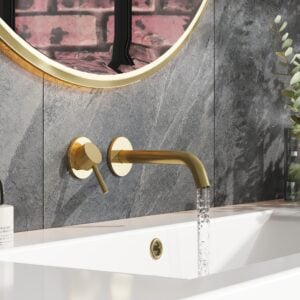
Wall-mounted basin taps
The tap fixes to the wall behind the basin rather than into the basin itself. It’s the cleanest look of the lot and frees up the whole basin surface, but the pipework has to be buried in the wall before the tiling goes on. Retrofitting onto a finished wall is possible but expensive and messy, so these are really a job for a new build or a full renovation. Covered properly further down.
Tap type at a glance
| Type | Best for | Basin holes needed | Difficulty to fit |
|---|---|---|---|
| Monobloc mixer | Most modern bathrooms | 1 | Easy |
| Two-hole mixer | Traditional 3-hole basins | 3 | Easy |
| Pillar taps | Period and heritage looks | 2 | Easy |
| Tall basin mixer | Countertop and vessel basins | 1 (in basin or worktop) | Easy to medium |
| Wall-mounted | Designer and new-build bathrooms | 0 in basin, pipework in wall | Hard |
Matching a Tap to Your Water Pressure
This is where most basin tap purchases quietly go wrong. UK homes run on wildly different water pressure depending on the heating system, and plenty of taps need more pressure than the house actually delivers. Buy a tap that wants 1.0 bar and feed it 0.3, and you’ll get a trickle and assume the tap is faulty. The tap is fine. You bought the wrong one.
Find out your pressure first
The quickest check costs nothing. Turn the tap on full and time how long it takes to fill a one-litre measuring jug:
- Under 6 seconds: high pressure, usually mains-fed from a combi boiler or unvented cylinder.
- 6 to 15 seconds: medium pressure, typical of most combi boilers and some pumped gravity systems.
- Over 15 seconds: low pressure, usually a gravity-fed system with a cold water tank up in the loft.
Not sure what system you’ve got? Have a look in the airing cupboard. A visible hot water cylinder points to gravity-fed or unvented. A wall-mounted boiler with no separate tank is a combi, which runs at mains pressure. If you want the bigger picture on this, our guide to choosing a shower when water pressure is low walks through the same systems in more detail and the jug test applies just as well to taps.
Read the bar rating, every time
Every tap has a minimum operating pressure on its spec sheet, given in bar. This is the single most useful number on the page, and the one people skip straight past. The rough bands:
- 0.1 to 0.2 bar: built for very low pressure. Look for taps that state low-pressure compatibility outright.
- 0.5 to 1.0 bar: the standard middle ground. Fine for most combi boilers and pumped systems.
- 1.0 bar and up: usually designer ranges, and they’ll struggle on a weak gravity setup.
Here’s a real, useful contrast from our own range. The Descent monobloc is rated from 0.2 bar, so it works on a gravity-fed loft-tank system. The Core Chrome monobloc, which looks broadly similar on the shelf, needs 0.5 bar. On a strong combi neither will know the difference. On a weak gravity system, one gives you a proper flow and the other dribbles. Same money territory, completely different result, and the only way to tell them apart is the bar rating.
Best Basin Taps for Low Water Pressure
There’s no such thing as a separate category of “low-pressure tap” you need to hunt down. What you’re looking for is a normal tap that states it works from 0.2 bar, because that figure is low enough to run on a gravity-fed system where the cold tank sits in the loft and there’s no pump pushing anything along. Get that number right and an ordinary monobloc or pillar pair will serve you perfectly well.
For a small basin or a cloakroom on an older system, the Victoria Mini Waterfall Basin Monobloc Tap with push-down waste at £49 is the one I’d reach for. It’s a compact waterfall-style tap built for cloakroom and small-basin use, runs from 0.2 bar upward, and crucially comes with both the push-down waste and the flexible hoses in the box, plus a ceramic disc cartridge and a solid brass body. For a small loo basin on a gravity feed, it’s a tidy, complete answer.
The other genuine low-pressure options are the ones already mentioned: the Descent Chrome monobloc at £49.99 for a single-hole basin, and the Premier or Forme pairs for a two-hole basin. All three are rated to 0.2 bar. If your pressure is genuinely on the floor, below about 0.1 bar even at the tap, no tap on its own will save you and you’re into pump territory, which is a plumbing job rather than a shopping one.
Tall Taps for Countertop and Vessel Basins
If your basin sits on top of the vanity unit rather than dropping into it, a standard-height tap won’t reach over the rim, and you’ll be splashing the worktop instead of filling the bowl. A tall basin mixer fixes that with a raised spout, typically somewhere between 250mm and 350mm above the surface. The trick is matching the spout height and reach to the bowl, so the water lands near the centre and you’ve still got room to get your hands under it.
The Muro Chrome Tall Basin Mixer Tap at £79 is the sensible default here: a tall monobloc design at around 314mm, solid brass, with a ceramic disc cartridge and push-down waste compatibility. Note it needs 0.5 bar to run properly, so it suits a combi or pumped system rather than a weak gravity feed. For a design-led scheme where the figures need to be spot-on, the Litchfield Oro Brushed Brass Tall Basin Mixer Tap at £139 publishes the numbers that actually let you check fit: 305mm overall height, 214.5mm spout height and 136mm spout projection. With a bowl on top of a vanity, those three measurements decide whether the water lands in the basin or behind it, so it’s worth doing the maths before you commit. The Oro ships without a waste, so add one to the basket.
One thing worth saying plainly: don’t pair a tall tap with a low-set inset basin. All that height over a shallow bowl just turns hand-washing into a splash-fest. Tall taps earn their keep with deep countertop bowls, and look daft on anything else.
Wall-Mounted Basin Taps
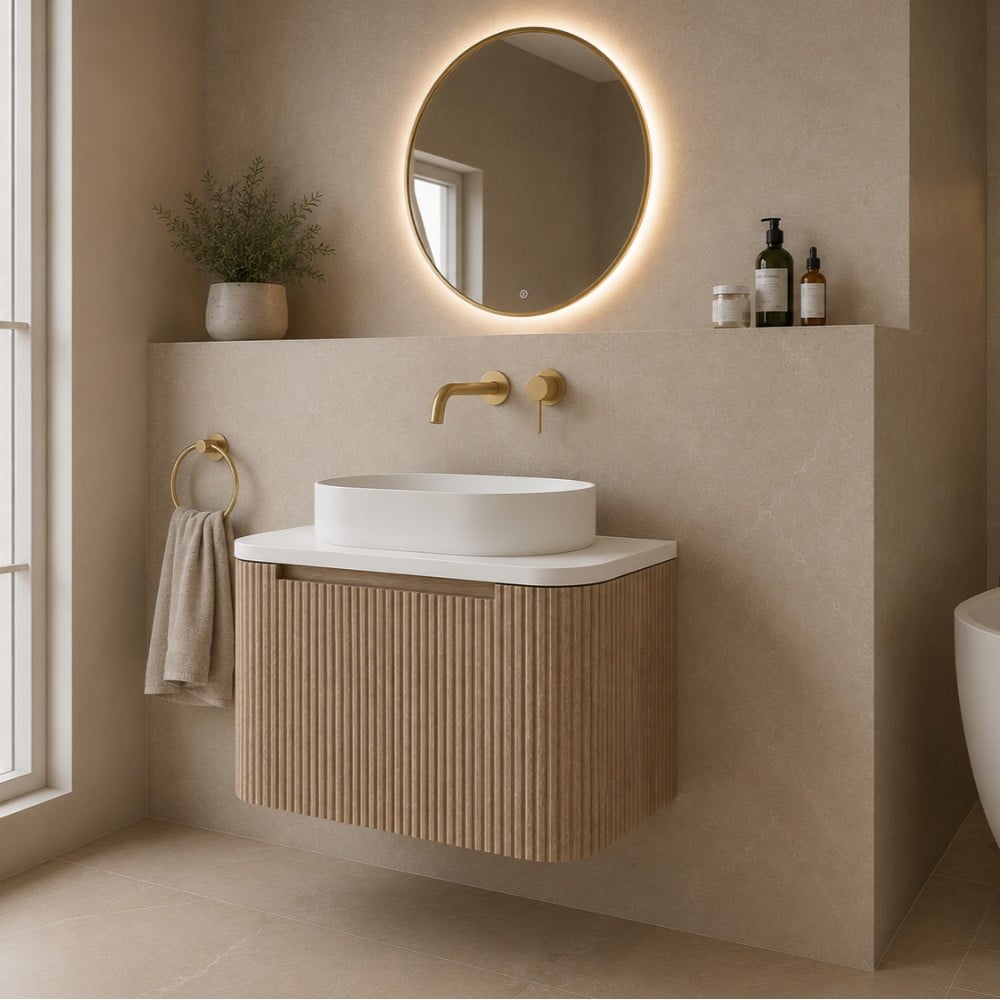
Wall-mounted taps mount through the wall behind the basin, with nothing on the basin surface at all. They give the cleanest, most minimal look you can get, free up the whole counter for soap and clutter, and pair beautifully with a countertop bowl. The catch is the fitting: the valve body and pipework live inside the wall, which has to be roughed in before the tiling goes up. That means this is a new-build or full-renovation decision, not a quick swap.
For a mid-priced chrome option, the Core Chrome Wall-Mounted Basin Mixer Tap at £79.99 covers the bases: polished chrome over solid brass, a ceramic disc cartridge, an aerated soft-flow spout and WRAS approval. The dimensions to plan around are 83mm height, 155mm width and a 186.4mm projection, and that projection is the one that matters, because it decides whether the spout actually clears the front edge of your basin. If you’re building a hotel-style scheme in warmer metal, the Litchfield Oro Brushed Brass Wall-Mounted Basin Mixer Tap at £169 is the step up: luxury brushed brass, a knurled handle for proper tactile grip, and it’s supplied with all the required fixings. Whichever you pick, mark the spout height and projection on the wall before the plumber buries anything, because once it’s tiled in, moving it is a demolition job.
Matching a Tap to Your Basin
Two things to check here: how many tap holes the basin has, and whether the spout reaches the right spot.
Count the tap holes
Look at the basin and count the holes. One hole means a monobloc. Two holes means pillar taps. Three holes means a two-hole mixer set. Zero holes usually means the basin is designed for a wall-mounted tap or a tall tap mounted through the worktop. Most modern basins have a single hole, most traditional ones have two or three, and most countertop bowls have none at all.
Spout reach and height
The water needs to land roughly in the middle of the bowl, not at the back wall and not over the front edge. The usual mistakes:
- Spout too short: water lands at the back near the wall. Classic result of putting a standard tap on a countertop bowl, which is exactly what tall taps exist to fix.
- Spout too long: water hits the front of the bowl or splashes over the rim. Happens with deep-reach taps on small, shallow basins.
- Spout too low: you can’t get your hands under it comfortably. Easy to do with a tall bowl when you’ve underestimated its height.
Rule of thumb: aim for the spout to land near the centre of the bowl, with at least 75mm of clearance between the spout and the rim so you can actually wash your hands. This is where those published figures on the Litchfield Oro and Core wall taps earn their keep. The reach number tells you, on paper, whether the water lands in the right place.
Picking a Finish
Finish is the bit most people decide first, but it’s genuinely the easiest call once the practical stuff is sorted. Here’s what works where:
- Chrome: the default. Works in every style and every budget, it’s the cheapest finish and the easiest to wipe down. The downside is it shows watermarks more than anything else, so in a hard water area you’ll be wiping it often.
- Brushed brass: warm, modern, with traditional roots, and it suits both contemporary and period rooms. The matte-gold surface hides fingerprints and water spots far better than chrome, which is half the reason it’s so popular right now.
- Matt black: bold and low-reflective, hides watermarks well but shows limescale in hard water. Cheap matt black taps lose their finish fast, so buy from a brand with a proper guarantee.
- Brushed nickel and gunmetal: warmer than chrome, calmer than black. They suit Scandi-style and industrial schemes.
If brushed brass is the look you’re after, there’s real choice at different prices. The Montana Brushed Brass Basin Monobloc at £74.99 is the easy way in: premium brass with a brushed finish, a single-lever ceramic disc mixer, a sleek curved spout, flexible hoses in the box, and that matte-gold surface that shrugs off fingerprints. The Core Brushed Brass Monobloc at £109 has a ceramic disc cartridge, flexi tails included, a WRAS-approved cartridge and a choice of a diamond cross-hatch or smooth lever handle. The waste is sold separately on that one, so add one in. And if you’re going brushed brass across the whole room, our brushed brass bathroom style guide covers how to keep it consistent without it tipping into too much.
One rule that saves regret: stick to one or two finishes across the bathroom. Chrome taps, a matt black towel rail and a brushed brass shower head in the same room looks like you couldn’t make up your mind. Pick a hero finish, add one accent if you want contrast, and stop there.
Fitting Tips and Pitfalls
Most basin taps can be fitted by a competent DIYer. Some can’t. Here’s what to check before you start.
- Check what’s actually in the box. This is the one that trips people up. Some taps include the waste and the flexible tails, some include neither. The Descent and Victoria both ship with a waste, while the Core Chrome monobloc and the Litchfield Oro tall both arrive without one. Read the spec, and order the waste and tails at the same time if they’re not included, so you’re not stuck halfway through the job.
- Fit isolator valves. If the hot and cold supplies don’t already have isolator valves, fit them now. They let you shut off the water to the tap without draining the whole house, and they’ll save you hours of grief at the next service. Cheap, and well worth it.
- Check the flexi tail thread and length. Most modern taps come with flexible tails. Make sure they reach your supply pipes and that the thread is right, as 15mm is the UK standard.
- Hand-tight, then a quarter turn. Over-tightening fittings is the most common cause of leaks, not under-tightening. Nip it up by hand, give it a quarter turn with a spanner, then check for drips once the water’s been on a minute.
- Always fit new washers and seals. Don’t reuse the old ones. The couple of pounds you save isn’t worth the call-out when it weeps.
- Test hot and cold. Run the tap for two minutes and check under the basin for drips on both sides. Some leaks only show on the hot side once the fitting warms up and expands.
- Get a plumber for wall-mounted taps. If you’re fitting wall-mounted taps for the first time rather than replacing existing ones, this is a plumber’s job. The valve and pipework have to be set in the wall before tiling, and there’s no fudging it afterwards.
Frequently Asked Questions
What is the difference between a monobloc and a mixer tap?
A monobloc is one type of mixer tap, where hot and cold mix inside a single body operated by a single lever and fed through one tap hole. “Mixer” is the wider category that also covers two-hole mixers, where the valves are separate but still feed one spout. So every monobloc is a mixer, but not every mixer is a monobloc.
Do I need a special low-pressure basin tap?
If your home is gravity-fed, with a cold tank in the loft and a hot cylinder in the airing cupboard, then yes, you need a tap rated to run at low pressure. There’s no separate product type to hunt for, though. Just look for one that states it works from 0.2 bar, like the Descent monobloc, the Victoria Mini Waterfall, or the Premier and Forme pillar pairs. Combi boilers and unvented systems usually deliver plenty of pressure for standard taps.
How do I know if a tap will fit my basin?
Count the tap holes first. One hole means a monobloc, two means pillar taps, three means a two-hole mixer set. Then check the spout reach against the width and depth of the bowl. You want the water landing near the centre with at least 75mm of clearance under the spout for washing your hands. For countertop bowls, check the spout height too, or the tap will be too short.
Which tap finish is easiest to clean?
Chrome is the easiest to wipe down but shows watermarks the most, which is noticeable in hard water areas. Brushed brass hides fingerprints and water spots better day to day, though limescale will eventually show. Matt black hides daily marks well but needs gentle cleaning so you don’t strip the finish.
How much should I spend on a basin tap?
A complete, low-pressure-friendly chrome monobloc like the Descent comes in at £49.99 with the waste included, which is about as cheap as you should go for something with a brass body and a real cartridge. A solid brushed brass monobloc sits around £75 to £109, and a design-led tall or wall-mounted tap in brushed brass runs to roughly £139 to £169. Below about £30, the working parts and the finish are where the corners get cut.
Can I fit a basin tap myself?
Most monobloc and pillar taps, yes, with basic tools and isolator valves on the supplies. Tall taps are easy to medium, depending on access under a countertop basin. Wall-mounted taps are a plumber’s job if you’re fitting them from scratch, because the pipework has to be in the wall before tiling.
What is a pillar tap and do I still need two of them?
Pillar taps are separate hot and cold taps with no mixing, one for each of the two holes in a traditional basin. You do need both, sold as a pair like the Premier or Forme sets. They suit period and heritage looks, but bear in mind there’s no blending, so you’ll either plug the basin to mix or get used to washing under separate hot and cold streams.
Ready to start looking? Browse the full range of basin taps, or jump straight to pillar basin taps, tall basin taps or wall-mounted basin taps if you already know the shape you need. If your basin is part of a bigger project, our guide to designing a small bathroom is worth a look, and wall-hung versus floor-standing bathroom furniture helps you settle on the vanity your tap will sit on. Not sure a specific tap suits your pressure or basin? Send us the model and we’ll check it for you.