Wall Hung vs Floor Standing Vanity Units
Bathrooms
This is the biggest decision in bathroom furniture, and most people make it on looks alone. Here’s the honest answer: wall hung units float off the wall, make small rooms feel bigger and are far easier to clean around. Floor standing units sit on the floor, give you more storage and don’t care what your wall is made of. If your bathroom is small and your wall is solid masonry, go wall hung. If it’s a busy family bathroom, or the wall behind is plasterboard with nothing to fix into, floor standing is the safer call.
That’s the short version. The longer version is where it actually matters, because the wall behind your basin decides whether a wall hung unit is even an option, and the storage you need decides whether floor standing earns its slightly bulkier footprint. This guide covers wall strength, plumbing height, storage, cleaning and the real-world feel of each, with specific units you can buy to back it up.
- Wall hung vs floor standing: quick comparison
- When a wall hung vanity unit wins
- When a floor standing vanity unit wins
- Wall strength: can your wall actually take it?
- Plumbing, pipework and how forgiving each one is
- Storage and sizes: which one actually holds more
- Cloakrooms and small spaces: the same job, two ways
- The middle ground nobody mentions
- FAQ
Wall Hung vs Floor Standing: Quick Comparison
If you just want the gist before the detail, here’s how the two formats stack up on the things that actually matter.
| Wall hung | Floor standing | |
|---|---|---|
| Best for | Small bathrooms, en-suites, modern schemes | Family bathrooms, larger rooms, traditional schemes |
| Storage | Slightly less at the same width | More, especially at 1000mm and up |
| Wall needed | Solid masonry, or stud reinforced first | Any wall, no load-bearing fixings needed |
| Plumbing | Pipes must line up with the bracket height | Pipes hide behind the carcass, far more forgiving |
| Cleaning | Easy, mop straight underneath | Fiddlier around legs or plinth |
| The look | Light, floating, contemporary | Grounded, solid, anchors the room |
The rest of this guide explains the why behind each row, and names units that prove the point.
When a Wall Hung Vanity Unit Wins
A wall hung vanity unit fixes to the wall on a concealed bracket and leaves the floor underneath completely clear. That one detail does most of the work. The visible floor tricks the eye into reading the room as bigger than it is, which is exactly why it’s the go-to in small bathrooms and en-suites where you can’t add a single physical centimetre but desperately want the room to feel less cramped.
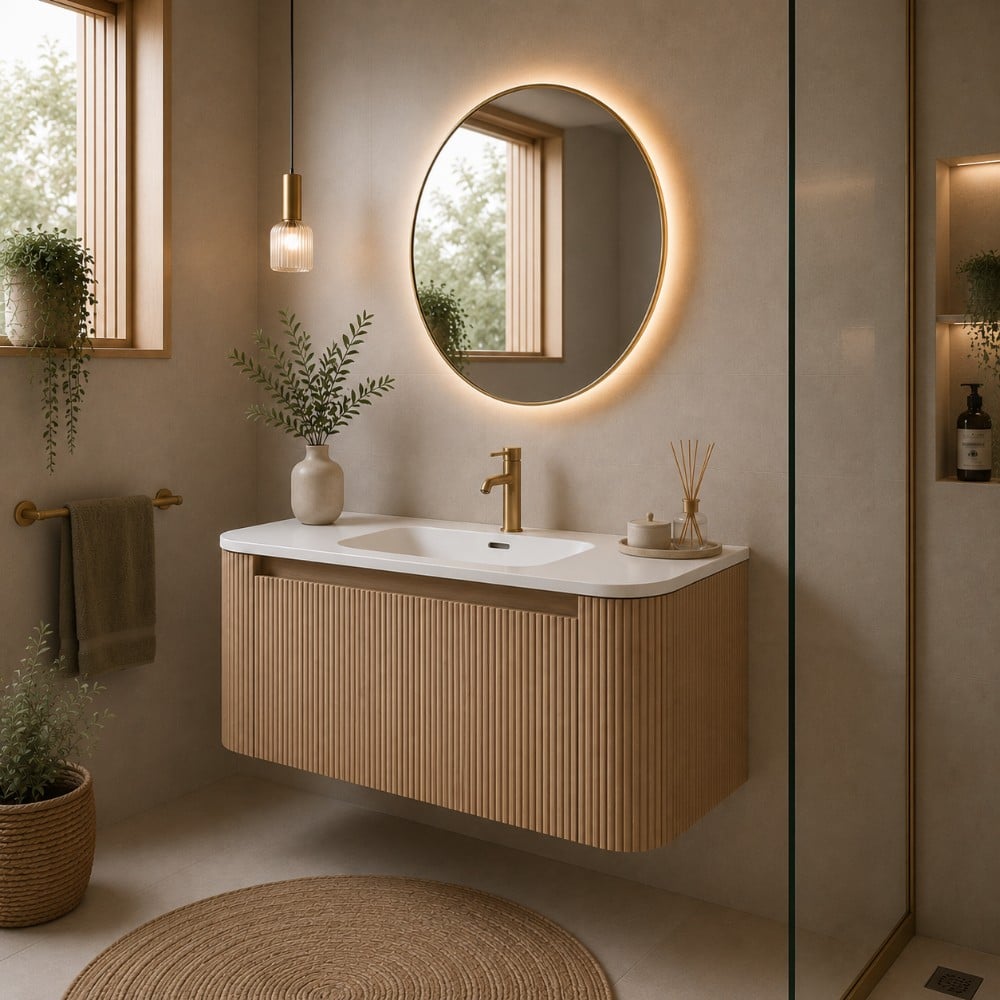
The Alfie 600mm Fluted Oak Wall Hung Vanity Unit & Basin at £399 is a good example of what that looks like in practice. It’s a compact 600mm size that the description calls “perfect for small to medium bathrooms and en-suites”, with a push-to-open handleless front and no visible handles to break up the clean line. It arrives pre-assembled, which is a small thing until you’ve spent a Sunday flat-packing a wardrobe and sworn off self-assembly furniture for life.
Wall hung isn’t only a small-room trick, though. Go up to the Flauto 800mm Oak Fluted Wall Hung Vanity Unit & Basin at £399.99 and you get a proper 800mm of storage (it measures 800 x 365 x 465 mm) while keeping that floating look in a main or family bathroom. It’s a moisture-resistant build with an integrated poly-marble basin and a 5-year manufacturer guarantee, and the description spells out the real benefit cleanly: the wall-hung design “creates a sleek floating appearance, enhances the sense of space and makes floor cleaning easier”.
Wall hung is the right call when:
- The room is small. A cloakroom, en-suite or compact bathroom feels noticeably bigger with the floor showing underneath. Visual space matters more than physical space when it’s tight.
- You want a modern, minimalist look. Wall hung pairs naturally with handleless fronts, fluted detailing and slim basins. It reads contemporary in a way a unit on legs never quite does.
- Cleaning is a faff you want to skip. No contact point with the floor means no dust trap, no hair gathering at the base, no scuffed plinth. You mop or vacuum straight underneath.
- You’ve got underfloor heating. Heat rises out from under the unit and circulates properly. A floor standing unit sits on top of the warmth and blocks it.
The trade-off is honest: storage is usually a touch lower than the floor standing equivalent of the same width, because some of the carcass depth goes to the bracket and the floating gap. And, the part people skip past at their peril, the wall behind has to be able to take the weight. More on that below, because it’s the bit that catches people out.
When a Floor Standing Vanity Unit Wins
A floor standing vanity unit rests on the floor, or on legs, and carries its full weight there. That makes it more forgiving to fit, usually bigger on storage, and completely indifferent to what your wall is made of. For a busy family bathroom, that last point alone often settles it.
The Amy Gloss White 600mm Floor Standing Two Door Unit & Basin at £229 is the one I’d point most people at first. The appeal is simple: as a floor-standing unit it needs no wall fixings at all. It’s a stable base with two soft-close doors, black handles and an integrated basin, and it suits “a wide range of layouts”. Budget-friendly, sturdy, and you can fit it against a stud wall without a second thought. If your wall is plasterboard with nothing solid behind it, this is your answer.
If you fancy a darker, moodier finish, the Scudo Empire 600mm Anthracite Floor Mounted Vanity Unit & Basin at £229 does the same job in anthracite, with a handleless recessed grip design, a gloss white ceramic basin included and a lifetime manufacturer’s guarantee. Like all floor-standing units, the carcass sits in front of the pipework and hides it completely. That’s a genuine practical win, covered properly in the plumbing section.
Floor standing is the right call when:
- It’s a family bathroom. More people, more stuff. Spare towels, cleaning products, shampoo bottles, kids’ bath toys. Floor standing swallows the lot, and at the larger widths it swallows a lot more than that.
- The room is large. A small floating unit can look a bit lost in a big room. A floor standing unit fills the space with more confidence and anchors the design.
- The wall is stud or plasterboard. If there’s no solid masonry and no timber to fix into, floor standing sidesteps the whole load-bearing problem. No fixings, no reinforcement, no worry.
- You’re replacing like for like. Swapping an old floor standing unit and not keen to re-route plumbing? Stay floor standing and the existing pipework usually still works.
- The scheme is traditional. Floor standing sits better with classic basin shapes and period-leaning bathrooms than a sharp floating box does.
The downsides are the mirror image of wall hung. A bit less floor on show, so the room reads slightly smaller, and the legs or plinth give dust and hair somewhere to gather. Cleaning around the base is fiddlier. Neither is a dealbreaker, they’re just the price of the extra storage and the easier fit.
Wall Strength: Can Your Wall Actually Take It?
This is the section to read before you fall in love with a floating unit. The single biggest reason wall hung vanity units fail is people fixing them to a wall that was never going to hold. A loaded vanity unit projects out from the wall, so the fixings cope with both the dead weight and the leverage of everything hanging off the front. It’s not a job for two screws into plasterboard and a hopeful expression.
Here’s what each wall type means in practice:
- Solid masonry (brick or block): No problem. Proper fixings into the masonry will hold any wall hung vanity unit you can buy. This is the ideal wall for going wall hung.
- Plasterboard on dot and dab: Risky for anything but the lightest units. You need longer fixings reaching the masonry behind, and for heavier units a plumber will often use chemical fixings. Don’t wing this one.
- Stud wall (timber frame): Only safe if there’s a noggin (horizontal timber bracing) at the right height behind the plasterboard, or you add a timber pattress before the unit goes up. Plasterboard on its own will not hold a loaded vanity unit reliably.
If you’re reading that list with a sinking feeling because your wall is stud and there’s nothing behind it, don’t force the issue. Go floor standing instead. The Amy 600mm floor-standing unit needs no wall fixings, so the wall behind it can be made of anything, or held up by nothing more than good intentions. The floor carries the load, the wall just gets a bracket to stop it tipping. That’s far less demanding than a full hung installation.
One thing I won’t do is quote you a kilo figure for what a given wall holds, because the safe load depends on your specific wall build, the fixings used and the unit weight, and a number plucked from a blog is worse than no number at all. If you’re set on wall hung and unsure about the wall, get a plumber or fitter to eyeball it before you buy. Five minutes of their time beats a basin on the bathroom floor.
Plumbing, Pipework and How Forgiving Each One Is
Wall strength gets the headlines, but plumbing is where wall hung quietly punishes a sloppy install. With a wall hung unit, the waste and supply pipes have to come out of the wall at the right height to meet the bracket and the basin’s connections. Get it right and it looks immaculate. Get it wrong, especially on a retrofit where you’re replacing a pedestal basin or an old floor standing unit, and the existing pipework almost never lines up. You’re then either chasing pipes into the wall or rethinking the whole thing.
Floor standing is far more relaxed about this. The pipes can usually exit anywhere within the unit’s footprint, and the carcass hides the lot. The Scudo Empire 600mm is a good example: like any floor-standing unit, the carcass sits in front of the pipework and hides it completely, so there’s no need to chase pipes into the wall for a tidy finish. If your plumbing is already in and you’d rather not pay someone to move it, that flexibility is worth real money.
It also opens up combination units, where a vanity and a WC share one run of furniture. The Empire 1100mm Combination Toilet & Sink Unit in Anthracite at £369 is a floor-standing example: a space-saving design that “combines a toilet and sink in one compact unit”, with a solid one-piece polymarble surface, an 18mm solid carcass, soft-close door hinges and a 5-year guarantee. A floor-mounted run like this can carry the plumbing for both the basin and the toilet behind the furniture, where a wall hung version would need a concealed cistern frame built into the wall. Two honest caveats so nobody assumes an all-in price: the back-to-wall toilet pan is not included, and the tap and basin waste are sold separately.
On floor: floor standing units assume a reasonably level floor. In older houses, or where a tiled floor was laid without much care, a unit can rock or sit slightly off. Adjustable feet help, but only so far. Wall hung sidesteps a wonky floor entirely, which is one of its quieter advantages in a period property.
Storage and Sizes: Which One Actually Holds More
Both formats come in the same standard widths, roughly 400mm (cloakroom), 500mm, 600mm, 800mm and on up to 1000mm and 1200mm. Pick based on the wall space you’ve genuinely got, measured with the door swing and any towel radiator clearance accounted for, not the space you wish you had.
At the same width, floor standing usually edges wall hung on raw storage, because none of the carcass is given up to a floating gap. Where floor standing really pulls ahead is at the big sizes. The Bota 1000mm Fluted Vanity Unit & Basin at £669 is the storage champion of this lineup: at “a generous 1000 mm width” the description calls it “ideal for master bathrooms or large en-suites”, with soft-close drawers and doors and a moisture-resistant build. If you need the most space for the least faff, a wide floor standing unit like this is the one.
For the look without losing the storage, the Bota comes floor-mounted with optional designer leg sets (Matt Black, Chrome, Brushed Brass and Gunmetal), which raise it off the floor for a part-floating effect. You get the visual lightness of something lifted off the ground and the full storage of a floor-standing carcass, without asking the wall to hold a thing. It’s a genuinely clever middle path, and the brushed brass legs in particular pair nicely with warm-metal taps if you’re building a scheme around that.
Drawers or doors?
Whichever format you choose, the door-versus-drawer question matters more day to day than wall hung versus floor standing. Drawers are more usable: you see everything at once, nothing gets shoved to the back and forgotten, and access is easier when you’re bending down. The catch is the runners. Soft-close drawer runners are the most common failure point on cheap units, so pay for decent ones or accept they may need replacing down the line. Door units are simpler mechanically and tend to hold bulkier items, the cleaning-product-and-spare-loo-roll stuff, with the bottom shelf being a slight reach.
A note on tall storage
If the vanity alone won’t hold everything, don’t oversize it, add a separate tall cabinet. A wall-mounted or floor-standing tall unit takes the towels and spare stock off the vanity and keeps your basin unit a sensible size. Bathroom Point’s Bella 1500mm tall cabinet is one such option for the overflow. Have a browse of the tall storage range to see what fits your wall.
Cloakrooms and Small Spaces: The Same Job, Two Ways
Nowhere is the wall hung versus floor standing decision sharper than in a cloakroom, where every centimetre is fought over and the answer genuinely goes either way. So here’s the same job solved both ways.
The wall hung answer is the Linea 400 Sonoma Oak Cloakroom Unit at £189, the smallest footprint here at 400mm. Its description calls the size “ideal for cloakrooms, en-suites and compact bathrooms”, with a wall-mounted design that “creates an open feel and simplifies floor cleaning”, plus a soft-close drawer and integrated basin. In a tiny cloakroom, that floating look and the visible floor underneath buy you a real sense of space you can’t get any other way.
The floor standing answer is the Esme 450mm Davos Oak Cloakroom Vanity Unit & Basin at £249. Compact at 450mm, with a soft-close door, an integrated basin and a lifetime guarantee, its floor-standing design “allows for easy installation and neatly conceals pipework for a clean, professional finish”. Crucially, it needs nothing load-bearing from the wall, so it’s the one to pick for a downstairs loo on a stud wall, which a lot of them are.
So which? If the cloakroom wall is solid and you want it to feel as open as possible, the Linea 400 wall hung. If the wall is dubious or you just want the simplest possible fit, the Esme 450 floor standing. Same tiny room, two clean answers. For more on squeezing a workable bathroom out of very little, our guide to designing a small bathroom goes deeper on layout, and if a WC choice is part of the job, how to choose a toilet covers that too.
The Middle Ground Nobody Mentions
The wall hung versus floor standing debate gets framed as either/or, but it isn’t always. Some units happily do both, which means you can commit to the look later, or change your mind without changing the unit.
The clearest example is the Linea Curve 600mm Wall Mounted Vanity Unit & Stone Cast Basin in Sonoma Oak at £525. It’s sold as wall-mounted, with a stone resin basin included and a design that “creates an open, airy feel and makes cleaning the floor area underneath simple”, plus a lifetime manufacturer’s guarantee. The detail that settles many a stalemate: it “can be floor-mounted if desired” with an optional brushed brass frame. So if you start wall hung and later find the wall won’t take it, or you simply prefer the framed floor-standing look, the same unit does both. It’s the rare product that lets you sit on the fence and still buy something.
The Bota’s optional legs, mentioned earlier, are the other version of this idea, a floor-standing unit lifted off the ground for a part-floating look. Between them, these two cover the “I can’t decide” crowd nicely. If even that doesn’t settle it, browse the full vanity units range and the fluted vanity units if you like that ribbed-front look that’s everywhere right now.
Frequently Asked Questions
Is a wall hung vanity unit a good idea?
Yes, if your bathroom is on the smaller side, your wall is solid masonry (or you’ll reinforce a stud wall first), and you value easier cleaning and a modern, open look over maximum storage. It’s probably not the right call for a large family bathroom with weak stud walls and a mountain of products to store. There, a floor standing unit will serve you better.
Can I fit a wall hung vanity unit to a stud wall?
Only if there’s a noggin (horizontal timber bracing) at the right height behind the plasterboard, or you add a timber pattress board behind the unit position first. Plasterboard on its own won’t hold a loaded vanity unit reliably. If the wall can’t be reinforced, pick a floor standing unit like the Amy 600mm, which needs no wall fixings and carries its weight on the floor instead.
Do wall hung vanity units hold less than floor standing?
Usually a little, at the same width, because some carcass depth goes to the floating gap and the bracket. The difference is small at 600mm but grows at the big sizes, which is why a wide floor standing unit like the Bota 1000mm holds the most of any in our range. If storage is the priority, floor standing wins. If space and looks are, wall hung is worth the slight trade.
What size vanity unit do I need?
For a cloakroom, 400 to 450mm. For an en-suite or small bathroom, 600 to 800mm. For a main family bathroom, 800mm up to 1000mm or more, depending on wall space. Always measure both the width and the depth of the available wall, and account for the door swing and any towel radiator clearance before you buy.
Is a wall hung vanity easier to clean?
Significantly. There’s no plinth or legs trapping dust and hair, no scuff line where the unit meets the floor, and you can mop or vacuum straight underneath. It’s one of the main reasons people go wall hung in the first place, and it’s a real benefit, not a marketing one.
Do wall hung vanity units fall off the wall?
Only if they’re badly fitted. Fixed properly into solid masonry, or into a correctly reinforced stud wall, they hold their load for years without drama. The horror stories you find online are almost always installation failures, the wrong fixings into the wrong wall, not the unit itself giving way. Get the wall and the fixings right and it stays put.
Can a vanity unit be both wall hung and floor standing?
Some can. The Linea Curve 600mm is sold as wall-mounted but its description confirms it can be floor-mounted with an optional brushed brass frame, so the same unit does both. The Bota 1000mm goes the other way, a floor-standing unit with optional legs that lift it for a part-floating look. Handy if you’re genuinely undecided.
Still weighing it up? Browse the full wall mounted vanity units and floor mounted vanity units to see the full range of widths and finishes. If you’re building a warmer scheme around brass taps and handles, our brushed brass bathroom style guide will help you match the metals, and once the unit’s chosen, our sink tap buying guide covers picking the right tap to sit on top of it.