Fluted, Reeded or Ribbed? Vanity Unit Styles Explained
Bathrooms
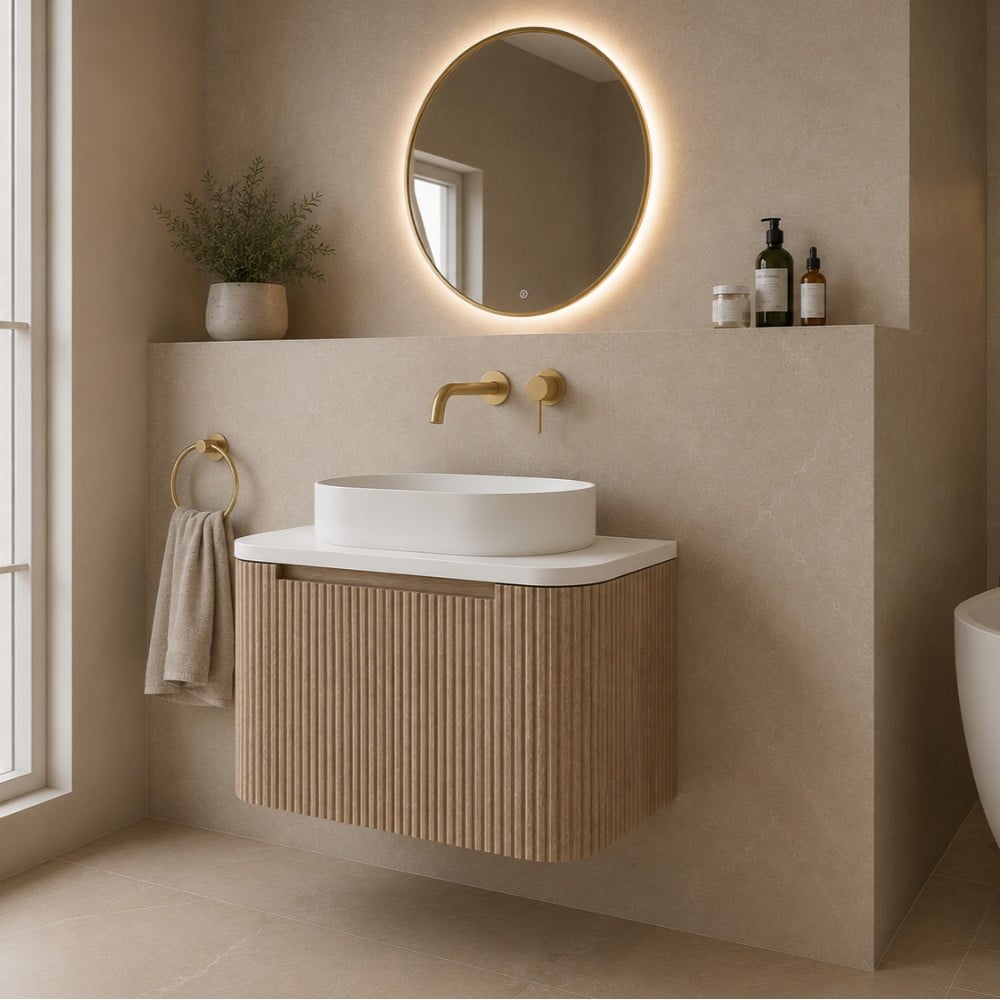
Fluted, reeded and ribbed all describe the same thing: a vanity unit with vertical grooves running down the front. There is no meaningful difference between them, it is just three words for the same look, so if you have been comparing a “ribbed vanity unit” against a “fluted” one thinking they are rival styles, relax. This guide covers what the style actually is, whether those grooves are a nightmare to clean, how to read a product listing so you know what you are buying, and which size and finish makes sense for your room.
- What does fluted actually mean?
- Are the grooves a cleaning nightmare?
- How to tell solid oak from foil-wrapped in a listing
- Which size fits your room
- Finishes: country oak, sonoma oak and the walnut question
- FAQ
What does fluted actually mean?
Fluting is a run of parallel vertical grooves cut or moulded into the face of the unit. It comes from classical architecture, the grooves you see running up a stone column are flutes, and furniture makers borrowed the idea because it catches light and adds texture without adding colour or pattern. On a bathroom vanity it breaks up what would otherwise be a flat slab of a door, which is why it has taken off.
Here is the bit that saves you money and time. Fluted, reeded and ribbed are the same style. Strictly, in cabinetmaking, reeding is the raised convex opposite of a concave flute, but nobody selling bathroom furniture uses the words that precisely, and search treats them as synonyms too. A “reeded oak vanity unit” and a “ribbed vanity unit” will land you on the same sort of product. So shop by the look, not the label.
The look works because it is quietly classic rather than loud. It sits happily in a modern flat and an older house, and it pairs with brass, black or chrome taps without a fuss. If you want texture but you are nervous about anything too trend-led, fluting is about as safe as texture gets.
One practical thing the grooves do that flat doors cannot: they hide the odd fingerprint and light scuff. Because the surface is broken up into vertical lines, your eye reads the texture rather than the smudge, so a fluted door tends to look cleaner between wipes than a flat gloss one that shows every mark. That is a small point, but it matters on a piece of furniture that gets touched with wet hands ten times a day.
Are the grooves a cleaning nightmare?
Honest answer: no, but they are not zero effort either. The grooves are shallow and vertical, so they do not trap standing water the way a horizontal ledge does, and a quick wipe down with a damp cloth in the direction of the grooves clears splashes fine. The reason people worry is toothpaste flecks and dried water spots, which do sit in the channels a bit more visibly than they would on a flat door.
In real life it means an extra ten seconds when you wipe the unit down, running the cloth up and down rather than side to side. For the stubborn bits, an old toothbrush gets into the channels in seconds. Avoid gritty cream cleaners and scouring pads on any oak or painted finish, groove or no groove, because they dull the surface.
The one place to be a bit careful is the very bottom of the grooves near the basin, where water can pool if the unit sits below a countertop basin that overflows or drips. Give that strip a wipe when you do the taps and you will never see a water mark build up. Hard water areas will show limescale in the channels faster than soft water areas, so if you are on hard water, a quick wipe with a damp cloth after the worst splashes saves a scrub later.
My take: if your bathroom is the sort that gets a proper clean once a week and a wipe in between, fluting will not bother you. If you are the kind of person who is annoyed by any surface that needs thinking about, go flat. That is the whole calculation.
How to tell solid oak from foil-wrapped in a listing
This is the part worth slowing down on, because two units that look identical in a photo can be built very differently, and the difference shows up over years of a steamy bathroom. Fluted vanities are generally made one of three ways, and you can usually work out which from the wording of the listing.
- Solid timber: the flutes are cut into real wood. Warmest look, most forgiving of the odd knock because a scratch is still wood underneath. The listing will say solid oak or solid timber, not just “oak finish”.
- Veneer over board: a thin layer of real wood bonded to a stable core. Looks like solid, costs less, perfectly good for a bathroom as long as edges are sealed.
- Foil-wrapped or laminate MDF: the grooved shape is moulded and a printed wrap goes over the top. Cheapest, and it can look great, but the print is not real grain and a chipped edge shows the board underneath.
The words to hunt for are “solid”, “veneer”, “foil-wrapped” and “wood effect”. If a listing only says a colour like “oak” or “walnut” without one of those construction words, that colour is describing the look, not the material, so it is most likely a wrap or a finish rather than solid timber. None of these is wrong, they are just different price and durability tiers, so match the build to how hard your bathroom gets used and check the specific product page before you buy.
The other thing worth checking on the listing is whether the basin is included. On smaller cloakroom and 600mm units the basin often comes as part of the set, which saves you matching one up separately: the Flauto Mini cloakroom and the Alfie 600mm both come with their basin, for instance. On countertop styles the top is included and you sit your own countertop basin on it, which gives you more freedom on the basin shape but means a second purchase. The Flauto 600mm countertop unit, for example, comes with the countertop plus pre-cut basin and tap holes, so the drilling is done for you. The product page will spell out which, so read it rather than assuming from the photo.
Which size fits your room
Fluted vanities run from tiny cloakroom units up to a full 800mm statement piece, and the right one is mostly about the room, not the budget. Here is the ladder, smallest first.
For a downstairs loo or a genuinely tight ensuite, start around 400 to 460mm. At this width you get a working basin and a bit of storage for the spare loo roll and not much else, which is exactly right for a cloakroom. The Flauto Mini 460mm fluted cloakroom unit in country oak is the space saver here at £249, basin included, with a slim 500 x 300mm footprint and an 880mm height that suits a compact corner. There are 400mm fluted cloakroom options if you need to go even tighter. Our cloakroom vanity units buying guide goes deeper on squeezing a basin into a small space if that is the job.
The 600mm band is the family bathroom workhorse and where most people should land. You get a proper basin, real storage underneath, and it still fits a standard bathroom without eating the floor. The Alfie 600mm fluted wall hung unit in sonoma oak comes with the basin at £299, has a soft-close drawer so it shuts quietly, and carries a lifetime guarantee. The Flauto 600mm country oak fluted unit with countertop at £379 gives you a worktop to sit a countertop basin on if that is the look you are after, with the countertop and pre-cut basin and tap holes included and a soft-close drawer. It also comes in Midnight Shadow, Smoked Sage and Soft Coffee if country oak is not your colour, and is backed by a 5 year guarantee.
Top of the ladder is 800mm, which is a statement piece for a bigger bathroom and needs the wall space to earn it. The Alfie 800mm fluted unit in matt black with a marble effect stone countertop and open shelf is the flagship at £389, carries a lifetime guarantee, and it also comes in sonoma oak. If you are torn between hanging a unit off the wall and standing it on the floor, that is a separate decision worth getting right, and our guide on wall hung vs floor standing bathroom furniture covers the trade-offs so I will not rehash them here. All the fluted units above are wall hung, which keeps the floor clear and makes mopping easier.
| Width | Best for | What you get |
|---|---|---|
| 400 to 460mm | Cloakroom, tight ensuite | Basin plus minimal storage |
| 600mm | Family bathroom, most homes | Full basin plus real cupboard space |
| 800mm | Larger bathroom, statement wall | Wide top, open shelf, more storage |
Finishes: country oak, sonoma oak and the walnut question
Finish is where fluting either sings or falls flat, because the grooves show off the grain and colour more than a flat door would. The two oak tones you will see most are country oak and sonoma oak. Country oak is the warmer, more golden brown, the traditional oak look most people picture. Sonoma oak is a paler, cooler, slightly grey-tinged oak that reads more contemporary and Scandinavian.
Rough rule: country oak suits warmer schemes, brass or bronze taps, and older houses. Sonoma oak suits cooler, minimal, modern bathrooms and works a treat with black or chrome. If you want to browse tones side by side, the oak bathroom furniture range is the place to start, and the wider bathroom furniture range shows the fluted units alongside everything else.
A word on walnut, because plenty of people search for a walnut fluted vanity. Walnut is a deep, dark, chocolate-brown timber and it looks superb fluted. Right now the fluted units we stock are oak-based and matt black, not walnut, so if you have your heart set on true walnut you may not find it in the fluted line here. The honest steer is that a warm country oak gives you the closest feel in the current fluted range, and matt black gives you the dark, dramatic end of things if that was really what walnut was standing in for.
FAQ
What is a ribbed vanity unit?
A ribbed vanity unit is the same as a fluted one: a unit with vertical grooves running down the front. “Ribbed” is just a plainer word for the same texture, so you can shop the fluted range and the ribbed range as one and the same thing.
Is a reeded oak vanity unit different from a fluted one?
In everyday bathroom shopping, no. Purists will tell you reeding is technically the raised version and fluting is the recessed groove, but retailers and search engines treat “reeded oak vanity unit” and “fluted oak vanity unit” as the same style, so do not pay a premium chasing one word over the other.
Are fluted vanity units going out of fashion?
This is opinion, not fact, so take it as one bathroom person’s read: I do not think so, at least not soon. Fluting is a texture rather than a colour or a gimmick, and textured neutrals age far more slowly than bold colours or shapes do. Search demand for fluted furniture is still strong and steady rather than fading, and because the look leans classical it has a longer shelf life than most “of the moment” styles. If you like it, buy it, you are not backing a fad that dates in eighteen months.
Is a fluted vanity hard to keep clean?
Not really. The grooves are shallow and vertical so they do not hold water, and a wipe down the line of the grooves clears splashes. Toothpaste flecks show up a touch more than on a flat door, but an old toothbrush sorts the stubborn bits in seconds.
What width fluted vanity unit should I get?
For most bathrooms, 600mm is the sweet spot: real storage and a proper basin without dominating the room. Drop to 400 to 460mm for a cloakroom or tight ensuite, and go to 800mm only if you have a bigger bathroom and want a statement piece.
You might also find these useful: our guide to wall hung vs floor standing bathroom furniture if you are weighing up how to mount your unit, the cloakroom vanity units buying guide for squeezing a basin into a small loo, how to design a small bathroom for the wider layout, our guide to wall-hung vanity units for sizes, styles and storage, and our round-up of bathroom furniture trends to see where fluting sits against everything else.