Hinged vs Sliding vs Walk-In Shower Enclosures
Showers
The single biggest decision with a shower enclosure isn’t the glass thickness or the finish. It’s how the thing opens. A hinged door swings outward and needs clear floor space in front of it. A sliding door moves along its own track and needs none. A walk-in panel doesn’t open at all, because there’s no door to open. Pick the wrong one for your room and you’ll be squeezing past a half-open door every morning, or mopping the floor every time you shower.
This guide compares the three by the only thing that really matters at planning stage: the opening, and the space each one demands. There’s a quick comparison table near the end if you just want the verdict.
- Hinged, sliding and walk-in: the three openings
- Hinged shower doors: when they work
- Sliding shower doors and quadrants: the space-saver
- Walk-in enclosures: open, no doors, no moving parts
- Best shower enclosure for a small bathroom
- Frames and finishes: brushed brass, matt black and chrome
- Frameless and minimal-frame: the open look
- Which opening is right for you?
- FAQ
Hinged, Sliding and Walk-In: The Three Openings
Strip away the marketing and there are really only three ways into a shower enclosure. Everything else is a variation on one of these.
- Hinged. A door on hinges that swings open, usually outward into the room. Gives you the widest unobstructed opening to step through, but needs clear space in front to swing.
- Sliding. One or two glass panels that glide along a track. The opening is narrower than a hinged door, but it takes up zero floor space outside the enclosure. Quadrants use the same idea with curved doors that follow the corner.
- Walk-in. A fixed glass panel (or two) with no door at all. You walk straight in past the open edge. Most space-efficient and easiest to step into, at the cost of some splash containment.
The right answer comes down to your layout, not your taste. Measure the floor in front of where the shower will go before you fall in love with anything. The rest of this guide walks through each option and where it earns its place.
Hinged Shower Doors: When They Work
A hinged door gives you the cleanest, widest way in. It swings clear of the opening completely, so there’s no narrow gap to shuffle through and no track at the threshold to step over. If you’ve got the floor space, it’s the most comfortable enclosure to use, day in, day out.
The catch is that swing space. The door arcs outward into the room as it opens, so you need a clear stretch of floor in front of it, with nothing in the way. Hang it where it’ll clatter into the basin, the loo or a towel rail and you’ll regret it within a week. In a tight bathroom, a hinged door is often the first thing to rule out.
The Athena Hinged Shower Door in chrome from £339 is a good example of how flexible this format is. It’s a variable product, so you pick your door size and can add an optional side panel to turn an alcove door into a full corner enclosure. The hinged design gives smooth access and a more premium feel than a slider, which is why a lot of people choose it when the room allows. Just budget the floor space for the swing before you order the size.
Hinged doors suit:
- A recess or alcove with clear floor in front, where the door has room to swing.
- A corner enclosure, when paired with a fixed side panel.
- Anyone who wants the widest, most open step-in and isn’t fighting for every centimetre.
Sliding Shower Doors and Quadrants: The Space-Saver
A sliding door is the answer when an outward-opening door simply won’t fit. The panels run along a track, so the door never extends beyond the footprint of the enclosure. Nothing swings into the room, which makes a slider ideal where the shower sits opposite a wall, a vanity or a doorway.
The other quiet advantage is fit. Sliding doors are built with an adjustment range to cope with walls that aren’t perfectly square, which, in a real house, is most of them. The Litchfield Glide Chrome Sliding Shower Door 1200mm from £169 is built around exactly this: a space-saving sliding opening that’s ideal for bathrooms where outward-opening doors aren’t practical, with an adjustable fitting range for walls that aren’t perfectly square. You can add optional side panels to make a corner enclosure.
If you want a contemporary finish, the Litchfield i6 Matt Black 1000mm Sliding Shower Door from £159 does the same job in matt black. Its nominal width of 1000mm includes a flexible adjustment range from 950mm up to 990mm, which is genuinely useful in an older property where the opening is never the round number you hoped for. Add a side panel (a 760mm option is available) to complete the corner.
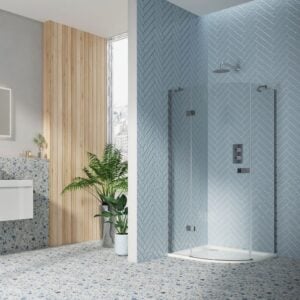
For a corner that’s really pushed for room, a quadrant is the slider’s smartest form. The doors are curved and slide around the corner, so the whole enclosure tucks into the angle of the room and the doors never project outward. More on quadrants in the small-bathroom section below.
Sliding doors suit:
- Bathrooms where there’s no room for a door to swing out.
- Showers sitting opposite a wall, a basin or the door into the room.
- Out-of-square or uneven openings, thanks to the built-in adjustment range.
Walk-In Enclosures: Open, No Doors, No Moving Parts
A walk-in enclosure has no door to open, close, slide or maintain. You step straight in past the open edge of a fixed glass panel. It’s the most accessible format going, the easiest to clean, and the look most people are actually after when they search for a walk-in shower: open, airy and uncluttered.
The Litchfield 8mm Matte Black 2-Panel Walk-In Shower Enclosure Pack at £309 is the format in its purest form: sleek matt black profiles, 8mm toughened safety glass, and a two-panel walk-in configuration that provides easy access with no doors or moving parts. Two panels give you more splash protection than a single screen while keeping that open, step-straight-in feel.
If you want a single fixed panel with the on-trend warm-metal finish, the Litchfield 8mm Brushed Brass Wetroom Glass Panel with Hinged Flipper at £249 is the one to look at. It’s 8mm toughened safety glass in a brushed brass finish, with an integrated hinged flipper (a small deflector panel) that swings to improve splash protection without turning the whole thing into a door. It’s sold by size, so the same panel is available in 700, 800, 900, 1000 and 1200mm widths. There’s a warmer brushed bronze version at £336 if you want the deeper metallic tone, and you can see the step up in price that the warmer finishes carry.
The honest trade-off with walk-ins: the open edge lets a little water escape, so you need a decent run of glass and a shower tray (or a graded wet-room floor) set up to drain it. Get the panel length right and that flipper earns its keep. If you’re weighing a walk-in against a fully tanked wet room, our guide to whether a walk-in shower is right for your bathroom covers that decision in detail.
Walk-in enclosures suit:
- Anyone who wants the open, modern look with the easiest possible access.
- Accessibility, since there’s no door and no high threshold to climb over.
- Bigger bathrooms, or a long wall where a generous panel can contain the splash.
Best Shower Enclosure for a Small Bathroom
In a small bathroom, the rule is simple: nothing should swing outward if you can help it. That rules a hinged door straight out unless your floor plan has room to spare, which small bathrooms by definition don’t. You want an enclosure that keeps every moving part inside its own footprint.
The corner quadrant is usually the winner. It fits neatly into the corner, its curved doors slide rather than swing, and that curved front claws back floor space you’d lose to a square enclosure. The Litchfield Glide Matt Black Double Door Quadrant 800 x 800mm at £189 is built for exactly this: a space-saving quadrant design that fits neatly into the corner, with a curved profile and a matt black aluminium frame, ideal for maximising available floor space. There’s a chrome version at £199 if you’d rather a classic finish.
If a quadrant doesn’t suit the layout, a straight sliding door in a recess is the next best thing, for the same reason: no outward swing. A walk-in panel can also work in a small room if you’ve got one long wall to run it along, though you’ll want enough panel length to keep the water in. The thing to avoid is forcing a hinged door into a space where it’ll foul the basin or the loo every time it opens.
For more on squeezing a proper shower into a tight room, see our small bathroom design guide and the dedicated quadrant and corner enclosure guide.
Frames and Finishes: Brushed Brass, Matt Black and Chrome
Once you’ve settled the opening, the finish is where the enclosure earns its looks. Chrome is the safe, classic default and tends to be the cheapest. Matt black is the contemporary go-to and hides watermarks better than polished chrome. Brushed brass and brushed bronze are the warm, on-trend finishes, and they carry a price premium, as the £249 brass panel versus the £336 bronze one shows.
A couple of practical notes. Matt black and the brushed metals show limescale less obviously than mirror-polished chrome, so they’re a touch more forgiving between cleans, especially in a hard water area. And whatever the frame, hold out for 8mm toughened safety glass where you can. It feels more solid, hangs straighter and simply looks better than thinner 6mm glass, which is more common on budget quadrants.
If you want to run a single metal through the whole room, match the enclosure frame to your taps, towel rail and accessories. Our brushed brass bathroom style guide covers how to do that without it looking like a showroom. You can also browse the brushed brass shower doors and enclosures range to see what’s available in the warm finish.
Frameless and Minimal-Frame: The Open Look
“Frameless” gets searched a lot, and it’s worth being straight about what it means. A truly frameless enclosure does away with most of the visible metalwork, leaving the glass to do the talking. The closest thing in practice is a minimal-frame walk-in panel: a single fixed sheet of glass with only a slim wall profile holding it, and no door framing at all.
The wetroom glass panels above are the best fit for that brief. A single 8mm panel with a hinged flipper gives you the clean, open, almost frameless look without the fragility (or the price) of a fully frameless hinged enclosure. You get the uncluttered glass, the easy clean, and a finish in chrome, matt black, brushed brass or bronze.
If the minimal look is the priority, go walk-in. The fewer the moving parts and the slimmer the framing, the closer you get to that open, frameless feel, and the less there is to keep clean. Browse the full walk-in shower enclosures range and the walk-in glass panels to compare.
Which Opening Is Right for You?
Here’s the short version. Match your room to the row and the answer drops out.
| Opening | Best for | Floor space needed | Step-in width |
|---|---|---|---|
| Hinged door | Recess or corner with clear floor in front | Swing space in front of the door | Widest |
| Sliding door | Tight rooms, out-of-square walls, door opposite a wall | None outside the enclosure | Narrower (half the door) |
| Quadrant (sliding) | Small bathrooms, corner installs | None, doors curve along the corner | Narrower, curved |
| Walk-in panel | Open look, accessibility, bigger rooms or long walls | None, no door at all | Widest (open edge) |
One thing to take away: hinged for comfort when you’ve got the room, sliding or quadrant when you haven’t, walk-in when you want the open look and the easy access and you’ve a wall to run the glass along. Measure the floor in front of the shower first, and the rest falls into place.
Frequently Asked Questions
What are the different types of shower enclosure?
By how they open, there are three: hinged (a door that swings outward), sliding (panels that glide along a track, including curved quadrant doors), and walk-in (a fixed panel with no door at all). Beyond the opening, you’ll see them sold by shape too, such as rectangular, square, quadrant and alcove or recess.
What is the best shower enclosure for a small bathroom?
A corner quadrant with sliding doors, in most cases. It tucks into the corner, the curved doors slide rather than swing, and nothing projects into the room. The Litchfield Glide Matt Black Double Door Quadrant 800 x 800mm at £189 is a good example. A straight sliding door in a recess is the next best option, since it also avoids any outward swing.
Do hinged shower doors need a lot of space?
They need clear floor in front to swing into, yes. That’s the main thing to check before buying one. If the door would foul the basin, the loo or a towel rail as it opens, choose a sliding door or a walk-in panel instead, both of which keep every moving part inside the enclosure’s own footprint.
Are walk-in shower enclosures a good idea?
For accessibility and the open, modern look, they’re hard to beat. There’s no door to open and no high threshold to step over, and they’re the easiest type to clean. The trade-off is splash: the open edge lets a little water escape, so you want a decent length of glass and a tray or wet-room floor set up to drain it. A panel with a hinged flipper helps contain the splash.
Is a brushed brass walk-in shower enclosure worth it?
If you’re matching it to brass taps and accessories, it pulls the room together nicely, and the warm finish hides limescale better than polished chrome. Expect to pay a premium over chrome, though. The Litchfield 8mm Brushed Brass Wetroom Glass Panel is £249, while the brushed bronze version is £336, so the warmer the metal, the higher the price.
What’s the difference between a sliding door and a quadrant enclosure?
Both slide rather than swing, so neither needs floor space outside the enclosure. A straight sliding door fits a flat wall or recess. A quadrant has a curved front with doors that slide around the corner, so it fits diagonally into the corner of the room and saves even more floor space, which is why it’s the usual pick for the smallest bathrooms.
How thick should the glass on a shower enclosure be?
Go for 8mm toughened safety glass where the budget allows. It feels more solid, hangs straighter and looks better than 6mm glass, which is more common on budget quadrants. All the enclosures worth buying use toughened safety glass, so that part is standard, it’s the thickness that varies.
Still weighing it up? Browse the full shower enclosures range at Bathroom Point, or jump straight to hinged doors, sliding doors or walk-in enclosures. Once you’ve settled the opening, our guide to what size shower tray you need sorts out the base, and our guide to choosing shower doors goes deeper on the door itself.