Bathroom Radiators & Heated Towel Rails: 2026 Guide
Accessories
A bathroom radiator does two jobs at once: it heats the room and it warms your towels so you’re not grabbing a cold one at 7am. Most people pick on looks alone, end up with something too small to heat the room, then wonder why the bathroom never feels warm. Get the output roughly right first, match the finish to your taps, then pick valves that suit how your pipes come in. Do those three things and the rest is straightforward.
This guide runs through the main types, a no-maths way to size one, what the finishes actually mean for heat and looks, the valve choice that trips people up, and how dual fuel lets you run the rail in summer with the heating off. There’s a quick sizing table near the top if you just want a number to aim for.
- Bathroom radiator and towel rail types
- What size radiator for your bathroom
- Anthracite vs black vs brass vs bronze vs gunmetal
- Dual fuel and electric: warm towels in summer
- Valves and pipe centres
- Fitting, positioning and tidying the pipes
- FAQ
Bathroom Radiator and Towel Rail Types
Nearly every bathroom radiator falls into one of three shapes: a ladder towel rail, a straight vertical rail, or a column/designer radiator. Here’s what each is good at, with a real example so you can see the kind of money and output involved.
Ladder towel rails (the default, and rightly so)
Horizontal bars stacked up like a ladder, with pipes joining them at either side. Towels hang on the bars, the whole thing heats the room, job done. For most UK bathrooms this is the right answer, which is why the ladder towel rail range is the biggest part of the catalogue.
The workhorse pick is the Strive 500 x 1600 Anthracite Ladder Towel Radiator at £129. It’s a tall, 26-bar rail in a 4 + 6 + 6 + 10 layout, 508 mm wide and a generous 1600 mm high, that puts out around 628 W (about 2142 BTU at delta-T 50°C). That’s enough to be the only heat source in a medium to large bathroom, not just a towel warmer hung next to a separate radiator. It’s a slim 30 mm deep with roughly 90 mm projection off the wall, made from low-carbon steel in a textured carbon anthracite finish, and it carries a 5-year guarantee. If you want a modern rail that actually heats the room, start here.
Best for: medium to large family bathrooms where you want real room heat and warm towels from one contemporary unit.
If you’re kitting out a second bathroom or an en-suite and don’t want to spend much, the Harrison Life Matt Black Heated Towel Radiator at £84.99 (the 450 x 1200 mm size) is the sensible entry point. It’s a high-output ladder-style rail in a sleek matt black finish with a 5-year guarantee, and it comes in multiple sizes so you can scale it to the wall. Matt black is bang on trend right now and this is about the cheapest tidy way to get it.
Tight on wall height? The Elizabeth Carbon Anthracite Heated Towel Radiator at £109 in the compact 500 x 800 mm size is the cloakroom and small en-suite answer. Same anthracite ladder look as the Strive, just sized down for a wall that won’t take anything tall. Valves are sold separately, as they are on most rails (more on that below).
Straight vertical rails
A straight rail keeps a slim vertical profile and squeezes onto a narrow wall where a wide ladder won’t fit. The Brushed Brass Straight Towel Radiator at £129 (the 800 mm height) is the one to look at: a sleek wall-mounted rail in mild steel with an elegant brushed brass finish, in a vertical layout that maximises wall space. It comes in multiple sizes, so you can run it up a tall narrow gap beside a basin or the door. If you’ve already gone brushed brass on the taps, this ties the wall together without eating space.
Best for: narrow walls, awkward gaps, and coordinating with brass taps and accessories.
Column and horizontal designer radiators
Not every bathroom wants a towel ladder. If towels aren’t the priority but you want a period or designer look, or you’ve got a low wall run beneath a window, a horizontal column radiator does the job. The Litchfield 2 Column Horizontal Designer Radiator at £189 is 600 x 830 mm in a crisp white finish (RAL 9016), a two-column, 18-bar configuration in low-carbon steel. At only 70 mm deep it’s ideal under a window or in a room with limited wall height, where a tall rail simply won’t go. You won’t hang as many towels on it, so pair it with a wall hook or a small rail if drying capacity matters. Have a look through the column radiator range to compare sizes.
Best for: under windows, low-wall runs, and period or designer bathrooms where towels take a back seat.
One thing worth clearing up early: Bathroom Point doesn’t stock electric-only panel radiators that just plug into the wall with no plumbing. The electric option here is a dual-fuel conversion of a normal wet rail, which we cover properly further down.
What Size Radiator for Your Bathroom
You don’t need to do maths to get this roughly right. Heat output is measured in BTU (British Thermal Units) or watts, and the bigger the room, the more you need. Pick something with too little output and it’ll run flat out and still never warm the room.
Here’s a rough guide to aim for. Match your bathroom to the band and you’ll be in the right ballpark.
| Bathroom size | Rough heat output to aim for | Example from this guide |
|---|---|---|
| Cloakroom / WC (under 4 sq m) | Around 1,500 BTU | Elizabeth 500 x 800 (compact) |
| Small bathroom / en-suite (4 to 6 sq m) | Around 1,600 to 2,000 BTU | Harrison Life 450 x 1200 |
| Standard family bathroom (6 to 9 sq m) | Around 2,000 to 3,000 BTU | Queenstown Brushed Bronze (2,005 BTU) |
| Large bathroom (9 sq m and up) | 2,000 BTU and up, often two rails | Strive 500 x 1600 (~2,142 BTU) |
If you want a precise figure for your exact room, there are plenty of free online BTU calculators that take your dimensions and spit out a number in a few seconds. For most people, matching the band above is plenty.
Two things that catch people out. First, if you’re between two sizes, go up. An oversized rail on a thermostatic valve simply throttles back once the room’s warm, whereas an undersized one runs constantly and never gets there. Second, watch the small print on output figures. The Queenstown Brushed Bronze Heated Towel Rail (450 x 1200 mm, £369) is rated at a strong 2,005 BTU, a solid single source for a standard family bathroom. But outputs are quoted at a delta-T, the gap between the rail’s temperature and the room’s. A figure quoted at 60°C will always look bigger than the same rail quoted at 50°C, so when you compare two rails, check they’re measured the same way before deciding one runs hotter than the other.
Anthracite vs Black vs Brass vs Bronze vs Gunmetal
Finish is mostly about looks, but there’s a heat angle too that most buyers miss. Matt finishes (anthracite, black, brass, bronze, gunmetal) radiate heat well and give you the full output on the spec sheet. Chrome is reflective, so a chrome rail emits a touch less radiant heat than the same rail in a matt finish. Not a dealbreaker, but if you’re heating a big room and torn between two, the matt one works slightly harder.
Anthracite is the modern default, and for good reason. It’s a dark matt grey that hides watermarks and limescale, goes with matt black taps and accessories, and gives you full output. The Strive and Elizabeth rails above are both anthracite, and it’s the safe choice if you’re not sure.
Matt black is the other on-trend dark finish, a bit sharper and more graphic than anthracite. The Harrison Life rail above is the easy way in. It pairs with black brassware and black accessories for a coherent modern look without much spend.
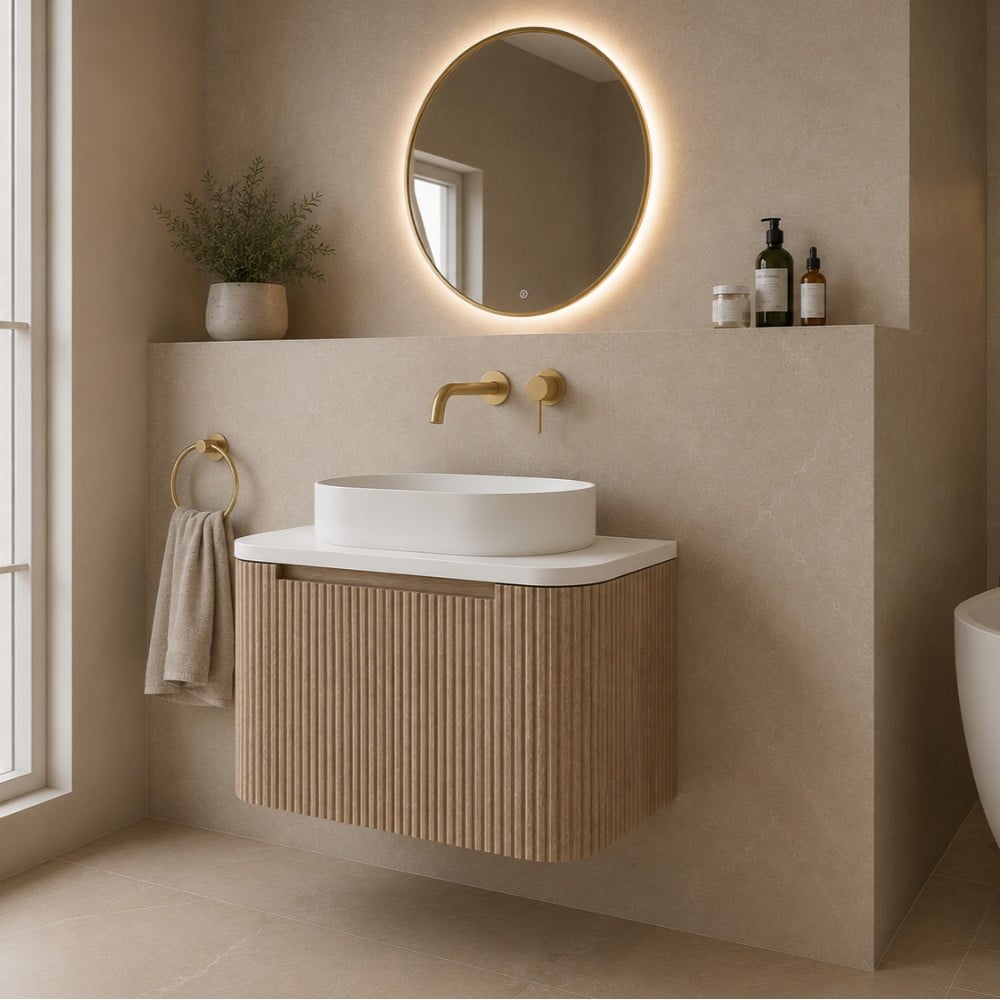
Brushed brass is the warm, slightly luxe option that’s everywhere right now. The Brushed Brass Straight rail above is the space-saving version; for a wider rail, browse the brushed brass towel radiator range. The rule: if you’ve already gone brass on the taps, go brass on the rail and the valves too. If brushed brass is the direction you’re heading, our brushed brass bathroom style guide covers how to pair it across the room.
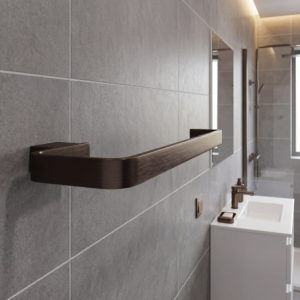
Brushed bronze is the less common, more statement warm metal. The Queenstown Brushed Bronze (mentioned above for its 2,005 BTU) wears a premium brushed bronze coating you won’t see in every other bathroom, which is rather the point. At £369 it’s the design-led pick when you want the rail to be the thing people notice. It’s dual-fuel compatible too, so it’ll run in summer once you add an element.
Gunmetal is the newer, moodier grey for people who’ve had enough of chrome but find black too stark. The VIBE Gun Metal Heated Towel Rail at £159 (the 500 x 1200 mm size) is a minimalist ladder-style vertical designer rail in a sophisticated gunmetal grey, built in durable steel and compatible with both central heating and dual-fuel systems. It sits in the gunmetal towel radiator range if you want to size up or down. This is the one to pick when you want something beyond the usual chrome, anthracite and black.
The rule that matters: match the rail finish to your taps and your valves, not to the tiles. Brass rail, brass taps, brass valves. Anthracite rail, anthracite or black taps, anthracite valves. Mixing metals on the same wall is the quickest way to make an expensive bathroom look unplanned.
Dual Fuel and Electric: Warm Towels in Summer
Here’s the question everyone eventually asks: how do I keep my towels warm in July when the central heating’s off? A standard wet rail runs off your boiler, so when the heating’s off, the rail’s cold. The fix is dual fuel.
Dual fuel means the rail is plumbed into your central heating and fitted with an electric heating element. In winter it runs off the boiler with everything else. In summer you close the rail’s valves and run it on the element instead, so you get warm towels without firing up the whole house. Most rails in the catalogue (the Queenstown, the VIBE and others) are described as dual-fuel compatible, but read that carefully: it means the rail can be converted, not that it arrives ready to plug in. The element and the connector are bought separately.
There are two parts to the conversion:
- The T-piece connector. The Litchfield Anthracite Dual Fuel T-Piece Radiator Connector at £9 is the small brass part that turns a normal wet rail into a dual-fuel one. It combines a valve and an electric element into a single inlet, so the rail can run off central heating and an electric element from the same connection. It’s finished in anthracite to match an anthracite rail and valves.
- The heating element. This is the bit that actually heats the rail electrically. The Litchfield Chrome Touch On/Off Heating Element (200W, £79) has a touch-sensitive on/off control, polished chrome finish, and fits many electric and dual-fuel rails using standard ½″ BSP connections. It comes in several wattages, so match the wattage to the rail size: a bigger rail wants a higher-wattage element to heat all that metal. You’ll find this and the full range in the electric elements range.
Match the element and T-piece finish to the rail. T-pieces come in chrome, white, anthracite and brushed brass; heating elements come in chrome, black or anthracite (in the Touch On/Off family) or chrome, white, anthracite and brass depending on the element type, so there is a match for most rail finishes. An anthracite rail gets an anthracite T-piece, a chrome element on a chrome rail, and so on. The whole point is that the conversion disappears into the rail rather than looking like an add-on.
Valves and Pipe Centres
Valves are the small, easy-to-forget bit that decide whether the whole thing looks finished or bodged. You need two per rail: one to control flow (a wheelhead, or a thermostatic valve) and one to balance the system (the lockshield). They’re sold separately from almost every rail, so budget for them and, crucially, match the finish.
Thermostatic or manual. A thermostatic radiator valve (TRV) senses the room temperature and throttles the rail automatically, so you can set the bathroom warmer or cooler than the rest of the house. The Matt Black Angled Thermostatic Radiator Valve & Lockshield at £33.99 is a tidy example: the thermostatic valve automatically regulates the flow of hot water by reacting to the room temperature, paired with a lockshield to balance the rail, both in an angled matt black body to suit a black or anthracite rail. Manual valves are just flow control and a bit cheaper. Go thermostatic unless your bathroom happens to contain the house thermostat.
Straight, angled or corner comes down to how your pipes meet the rail. Angled valves turn 90 degrees, which is the common setup when pipes come up out of the floor and the rail’s inlets face down, so the matt black angled pair above suits most installs. If you fancy a more characterful look, the Anthracite Angled Industrial Wheel Head Radiator Valves at £45.89 are a style-led option: solid brass with a 15 mm angled body, tool-free compression fittings, a textured matte anthracite finish and a wheel-head control, sold as a pair covering both flow and return with a 2-year warranty. They look right on an anthracite or industrial-style rail. Straight valves suit pipes coming straight up in line with the inlets; corner valves handle pipes from the wall when you want the valve flush against it. Look at where your pipes actually are before you order, because the wrong shape simply won’t reach. The full valves and accessories range covers every finish.
Pipe centres are the distance between the two valve connections at the bottom of the rail. If you’re swapping like-for-like, measure your existing centres and buy a rail that matches, or you’ll be paying a plumber to move pipework. Most rails take standard ½″ BSP radiator valves, so you’re not hunting for anything exotic, but the centres are what catch people out.
Fitting, Positioning and Tidying the Pipes
Where you hang the rail matters more than people think. A few rules from people who fit these for a living:
- On an outside wall. Counter-intuitive, but it’s where the room loses most heat, so it’s where the radiator does most good.
- Near the door, not on the far wall. A rail opposite the door has to push heat across a cold room before you feel it. Near the door warms the space faster.
- Within reach of the shower or bath. The whole point is grabbing a warm towel without dripping across the floor first. If you can reach it from the shower, you’ve hung it well.
- Not behind the toilet. Towels at that height collect splashes you’d rather not think about.
Wall strength. A full towel rail, water plus wet towels, can weigh a fair bit. Solid walls take anything. Stud walls need a noggin or a reinforcing batten behind the plasterboard where the brackets land, so sort that before the plasterer finishes, not after.
New pipework goes in before tiling. If you’re moving the rail or fitting one where there wasn’t one, get the plumber to run the pipes before the room is decorated. Pipework chased into walls or run under floors has to be done before the tiler arrives, not retrofitted around finished surfaces.
Hide the pipes. The detail that separates a tidy job from a rushed one is what happens between the floor and the valves. Bare copper or plastic on show undoes a lot of good work. A set of Litchfield Anthracite 130mm Radiator Pipe Sleeve Kit covers at £19 neatly conceals exposed pipework. Each sleeve is 130 mm long, fits standard 15 mm radiator pipes and can be cut to length, in an anthracite coating to match an anthracite rail and valves. It’s a few quid that makes the install look professionally fitted. There’s a wider pipe covers range for other finishes.
If the bathroom’s still feeling cold once the rail’s in, the radiator usually isn’t the whole story. Our guide to keeping your bathroom warm covers the heat-loss fixes (draughts, cold surfaces, underfloor heating) that work alongside a properly sized rail. And if you’re fitting out a tight space, designing a small bathroom has more on where everything goes.
Frequently Asked Questions
What size radiator do I need for my bathroom?
As a rough guide: a cloakroom needs around 1,500 BTU, a small bathroom or en-suite around 1,600 to 2,000 BTU, a standard family bathroom around 2,000 to 3,000 BTU, and a large bathroom 2,000 BTU and up (often two rails). The Strive 500 x 1600 puts out around 2,142 BTU, enough to heat a medium to large room. For an exact figure, plug your room dimensions into a free online BTU calculator. If you’re between two sizes, go up: an oversized rail on a thermostatic valve just throttles back once the room’s warm.
Are chrome towel rails less efficient than anthracite?
A bit, yes. Chrome is reflective and emits slightly less radiant heat than the same rail in a matt finish like anthracite, black, brass or gunmetal. It’s not a huge gap, but if you’re heating a large bathroom and choosing between two otherwise identical rails, the matt one works a touch harder. Chrome still looks great and goes with anything, it just shows watermarks more.
Can I run my towel rail in summer when the heating is off?
Only if it’s set up as dual fuel. A standard wet rail goes cold when the boiler’s off. Adding an electric element and a T-piece connector (like the £9 Litchfield Anthracite Dual Fuel T-Piece, plus a matching element) lets you run the rail on electric in summer, independently of your central heating. Most rails are dual-fuel compatible, meaning they can take an element, but it’s bought separately, not built in.
What’s the difference between a heated towel rail and a towel radiator?
In everyday UK use they’re the same thing: a rail that heats the room and dries towels. Strictly, “towel radiator” tends to mean a unit plumbed into your central heating, while “heated towel rail” sometimes implies an electric or dual-fuel setup. Both warm the room and your towels.
Do I need straight or angled radiator valves?
It depends on how your pipes meet the rail. Angled valves suit pipes coming up from the floor where the inlets face down, which is the most common setup, so something like the Matt Black Angled Thermostatic Valve and Lockshield covers most installs. Straight valves suit pipes coming straight up in line with the inlets. Corner valves are for pipes from the wall where you want the valve flush. Always match the valve finish to the rail.
Can a towel rail be my only bathroom heating?
Yes, as long as its output matches the room. A taller ladder like the Strive 500 x 1600 (~2,142 BTU) or the Queenstown (2,005 BTU) can heat a standard to medium family bathroom on its own. Smaller rails like the Elizabeth 500 x 800 are fine for cloakrooms and en-suites but may need pairing with underfloor heating in a big or cold room. Check the BTU figure against the sizing table above, not just the physical size.
How long do bathroom radiators last?
A quality rail with a properly maintained heating system lasts many years. Most here come with a 5-year guarantee. Failures usually come from corrosion when the system’s inhibitor hasn’t been topped up, or from a worn valve seal, rather than the rail itself giving out.
Ready to choose? Browse the full ladder towel rail range or the valves and accessories if you’re just upgrading what’s already on the wall. If the room runs cold generally, our guide to keeping your bathroom warm tackles the heat-loss side, the brushed brass bathroom style guide helps if you’re matching a warm-metal rail to the rest of the room, and designing a small bathroom covers fitting it all into a tight space. Not sure on sizing for your exact bathroom? Send us the dimensions and we’ll point you at the right rail.