Chrome vs Black vs Anthracite vs Brushed Brass Towel Rails
Accessories
Picking a towel rail finish comes down to one question: do you want it to vanish into the room or stand out? Chrome disappears and matches almost any tap. Black and anthracite make a statement and hide limescale better. Brushed brass is the warm, premium look that costs a bit more. There’s no wrong answer, but there is a right one for your room.
Below we’ll compare the four main finishes, sort out how to size a ladder rail so it actually heats the room, and cover the bit most guides skip: heated versus non-heated, and how to run any finish year-round.
- Chrome vs black vs anthracite vs brushed brass: the quick version
- Chrome towel rails
- Black towel rails
- Anthracite towel rails
- Brushed brass and bronze towel rails
- What size towel radiator do I need?
- Heated, non-heated, electric or dual fuel?
- Which finish is right for you?
- FAQ
Chrome vs Black vs Anthracite vs Brushed Brass: The Quick Version
If you just want the short answer, here’s how the four finishes stack up before we get into the detail:
- Chrome. Bright, reflective, matches almost any tap and accessory. The safe default that disappears into the room. Shows water spots more than the matt finishes.
- Black. Bold and modern, works as a focal point. Matt black in particular hides limescale and fingerprints well. The on-trend choice over chrome right now.
- Anthracite. A dark grey, often textured. Softer and less stark than gloss black, brilliant at hiding marks, and tends to come in the highest-output formats.
- Brushed brass. Warm, premium, statement metal. Commands a price step up over chrome and black. Pair it with brass taps or it’ll look like an accident.
The golden rule: pick the finish that matches your taps and accessories, not the one that matches your tiles. Tiles change with a redecorate. Your tap is staying put.
Chrome Towel Rails
Chrome is the benchmark for a reason. It’s bright, reflective, and goes with practically any tap, shower valve or accessory you’ve already got. If your bathroom is a mix of styles, or you’re not redoing the whole room, chrome quietly gets on with the job and never clashes.
The Strive Chrome Towel Radiator in 600 x 1200mm at £99.99 is a good example of the classic ladder. It’s built with 14 durable 22mm bars, and the chrome finish resists rust and tarnish even in humid environments, which matters in a room that steams up daily. It works with central heating and dual fuel systems and comes with a 5-year manufacturer’s guarantee.
The one honest downside of chrome: it shows water spots and limescale faster than the matt finishes. In a hard water area you’ll be wiping it down more often to keep it looking sharp. If that sounds like a chore, that’s where black and anthracite come in.
Black Towel Rails
Black is the finish people are actually searching for, and for good reason. It turns a functional bit of kit into a focal point. Against a white or light-tiled wall a black ladder rail looks deliberate and modern, the same way black taps and accessories have taken over bathrooms over the last few years.
For a medium bathroom, the Strive Matt Black 500 x 1200mm Heated Towel Radiator is the one to look at, at £74.99. It runs a 20-bar configuration in a 4 + 6 + 10 layout, with a heat output of around 1,648 BTU (roughly 483W) at delta T 50. The projection is a slim 30mm, so it sits close to the wall, and it’s dual-fuel compatible. A bold matt-black statement that’s hard to beat at that price.
Worth knowing: matt black is the practical choice as well as the stylish one. The finish hides fingerprints and water spots far better than chrome, so it stays looking clean with less effort. If you want the look to carry through the rest of the room, our guide to black bathroom accessories covers the bits that tie it together.
Anthracite Towel Rails
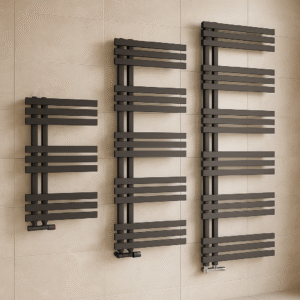
Anthracite is the finish to choose when you want dark but not stark. It’s a deep charcoal grey, usually with a slight texture, so it reads softer than gloss black while still giving you that modern, moody look. It’s also brilliant at hiding marks, which makes it a sensible pick for a busy family bathroom.
The other reason to look at anthracite: it tends to come in the highest-output formats, so it can double as the room’s main heat source. The Strive 500 x 1600mm Anthracite Ladder at £129 is a tall 26-bar rail in a 4 + 6 + 6 + 10 layout, delivering a high output of around 628W (2142 BTU) at 50°C, in textured carbon anthracite over low-carbon steel. In a small-to-medium bathroom a rail like this can genuinely heat the room on its own.
If you’ve got an awkward layout to work around, the Elizabeth Carbon Anthracite Heated Towel Radiator at £109 is a ladder-style rail that comes in multiple sizes with a wide range of BTU outputs, so you can match the output to the room rather than squeezing the room around the rail. More on getting that match right in the next section.
Brushed Brass and Bronze Towel Rails
Brushed brass is the warm-metal trend made real. Where chrome and black are cool tones, brass brings a soft golden warmth that works beautifully with white suites, dark tiles and natural materials like wood and stone. It’s the finish that makes a bathroom feel considered rather than just kitted out.
It does cost more, and it’s fair to ask why. The Auckland Brushed Brass Heated Towel Rail in 500 x 1200mm is £389. It has fifteen square-curved bars on a tall 1200mm height, with a finish powder-coated for durability and resistance to tarnish. It’s mild steel, dual-fuel compatible, puts out around 1385 BTU (413W), and the valves are sold separately. The price step up over chrome or black buys you a specialist coloured finish and a genuine statement piece, so brass is the call when the rail is meant to be seen, not hidden.
If you like the warm-metal idea but want something darker, brushed bronze sits between brass and black, a touch richer and less golden. The Litchfield Purity Brushed Bronze Wall-Mounted Towel Rail at £49.99 is an unheated coordinating rail, crafted from solid brass and powder-coated to resist tarnishing, corrosion and fingerprints. It’s a slim profile designed to sit alongside the Purity suite. For more on building a whole look around a warm metal, our brushed brass bathroom style guide is worth a read.
One niche option worth a mention: gunmetal. It’s a dark, gunmetal-grey metal finish that sits somewhere between anthracite and bronze, and it shows up on the odd heated rail rather than across a full range. If it’s the look you’re after it’s out there, just don’t expect the same choice of sizes you get in the four main finishes.
What Size Towel Radiator Do I Need?
Here’s where most people come unstuck. A towel rail has two jobs: dry your towels and help heat the room. Get the size wrong and it does neither well. Sizing is about two things, the physical space on the wall and the heat output (measured in BTU or watts) the room needs.
For the heat output, work out the room’s BTU requirement based on its size, then check the rail’s output figure against it. A small cloakroom or en-suite might need only a few hundred watts, while a family bathroom you want the rail to heat on its own needs a lot more. That’s why output varies so much across the range: the Strive Matt Black 500 x 1200 puts out around 483W, while the taller Strive Anthracite 500 x 1600 pushes around 628W. The taller, wider, more-bars rail does more heating. Simple as that.
For the physical fit, measure the wall space and watch two numbers:
- Width. Most ladder rails come in 300, 400, 500 and 600mm widths. A 500mm rail suits most bathrooms; go to 600mm if you’ve got the wall and want more towel-hanging room and more output.
- Height. This is where you buy output. Taller means more bars, more surface area and more heat. The Strive Anthracite at 1600mm tall is a high-output rail precisely because of that height.
- Projection. How far it sticks out from the wall. The Strive Matt Black projects just 30mm, which matters in a tight room where you don’t want to clip your elbow every morning.
If your room sits between sizes, or you’re not confident on the BTU sum, go for a range with multiple sizes so you can match the output to the room. The Elizabeth Carbon Anthracite range is built for exactly this. Honestly, it’s better to slightly over-size than under-size: an under-powered rail that leaves the room cold and the towels damp is a false economy.
Heated, Non-Heated, Electric or Dual Fuel?
Finish sorted, size sorted, now decide how it gets warm, if at all. Three routes, and the right one depends on your plumbing and how you use the room.
Central heating (the standard). The rail plumbs into your central heating circuit like any other radiator, so it heats up whenever the heating is on. Simplest setup, no running costs beyond your normal heating, and it’s how most of the rails above are designed to run. The catch: when the heating’s off in summer, so is your towel rail.
Dual fuel (the best of both). A dual-fuel rail runs off central heating in winter and an electric element in summer, so you get warm towels in August without firing up the whole house. Most of the rails above, including the Strive Chrome, Strive Matt Black and Auckland Brushed Brass, are dual-fuel compatible. You just add an element. The Litchfield Black Weekly Thermostatic Heating Element at £109 is a 600W element with a built-in LCD digital display, a 7-day timer with 24/7 scheduling and a thermostat adjustable between 7°C and 35°C, plus open window detection. Finished in black to coordinate with black rails, it turns any compatible rail into a year-round one.
Non-heated (the simple bar). If there’s no plumbing run to that wall, or the room’s already covered by another heat source, a non-heated towel rail is just a wall-mounted bar to hang and dry towels on. The Mono Black Wall Mounted Double Towel Rail at £79 is a good example: two rails for bath and hand towels, with a durable matt black coating that resists fingerprints and water spots. Most non-heated rails are accessory-style bars rather than full ladder rails, so they’re best as a supplement, not the room’s only towel solution.
If keeping the room warm is the bigger question for you, our guide to keeping a bathroom warm goes into heating the whole room rather than just the rail.
Which Finish Is Right for You?
Here’s the short version. Match your situation to the row and the answer falls out.
| Finish | Best for | Hides marks? | Price level |
|---|---|---|---|
| Chrome | Matching existing taps, mixed styles, a finish that disappears | No (shows spots) | £ |
| Black | A modern focal point, black taps and accessories | Yes (matt especially) | £ |
| Anthracite | Dark but softer, family bathrooms, high heat output | Yes | ££ |
| Brushed brass / bronze | A warm, premium statement, brass taps and natural materials | Yes | £££ |
One thing to take away: choose the finish to match your tap, size the rail for the room’s heat needs (not just the wall space), and go dual fuel if you want warm towels in summer. Get those three right and the rail does its job for years.
Frequently Asked Questions
Are black towel rails a good idea?
Yes. Black towel rails look modern, work as a focal point against light walls, and matt black in particular hides fingerprints and water spots better than chrome. They pair naturally with black taps and accessories. The Strive Matt Black 500 x 1200 is a solid, affordable place to start.
What size towel radiator do I need?
Match it to the room two ways: the physical wall space (width and height) and the heat output in BTU or watts. A small cloakroom needs only a few hundred watts; a family bathroom you want the rail to heat needs much more. Taller, wider rails with more bars give more output, so when in doubt, slightly over-size rather than under-size.
Is chrome or black better for a towel rail?
It depends on the look. Chrome matches almost any tap and disappears into the room, the safe choice for mixed or existing setups. Black makes a bolder, more modern statement and hides marks better. If your taps and accessories are black, go black; if they’re chrome or you want it to blend in, stick with chrome.
What is a non-heated towel rail?
It’s a wall-mounted bar for hanging and drying towels with no heating element, so it doesn’t warm up. They suit rooms with no plumbing run to that wall, or rooms already heated by another source. Most are accessory-style bars like the Mono Black double rail rather than full ladder rails, so they work best as a supplement.
What’s the difference between electric and dual fuel towel rails?
An electric towel rail runs solely off an electric element, independent of your central heating. A dual-fuel rail does both: central heating in winter, electric element in summer, so you get warm towels year-round without running the whole heating system. Add a thermostatic element like the Litchfield Black to make a compatible rail dual fuel.
Ready to choose? Browse the full towel radiators range or jump straight to black towel radiators at Bathroom Point. If you’re planning the whole room, our guide to comparing tap finishes helps you match the rail to your taps, and the small bathroom design guide is handy if space is tight.