Concealed Cistern and Frame: What to Buy, How High It Sits
Toilets
A concealed cistern and frame is the hidden half of a wall hung toilet: the cistern that holds the flush water and the frame that hides it in the wall and carries the pan. The choice comes down to one thing. If you are hanging a pan off the wall, you need the full frame, because the frame is what holds the weight. If the cistern is going behind furniture or into a solid wall you are recessing, you can buy the slim cistern on its own and skip the frame. Get that call right first and the rest is just matching parts.
Here is when you need a full frame versus a cistern on its own, how high the pan ends up sitting and how far it sticks out, what WRAS actually means for a cistern buried in your wall, and which push plate fits.
- Cistern-only or a full frame: which you need
- How high it sits and how far it sticks out
- WRAS: what the approval means for a hidden cistern
- Cistern-only vs frame kit: side by side
- Which concealed cistern and frame to buy: our BP picks
- FAQ
Cistern-only or a full frame: which you need
This is the fork that decides what you buy, so start here. A full frame is a floor-mounted chassis with the cistern built in. It is self-supporting, meaning it bolts to the floor and ties into the wall and carries the load itself, so the wall does not have to. A cistern on its own is just the plastic tank, slim enough to sit inside a stud cavity, and it needs something else to take the weight of the pan.
You need the full frame when a pan is hanging off the wall. That covers most wall hung jobs, and it is the only safe answer on a stud wall or on dot-and-dab, where the plasterboard cannot carry anything itself. The frame stands on the floor in front of the wall, so it does not care that the board is weak. If you are still working out exactly what carries the weight, our guide to wall hung ‘floating’ toilets covers what actually holds them up in full, then come back here to pick the cistern.
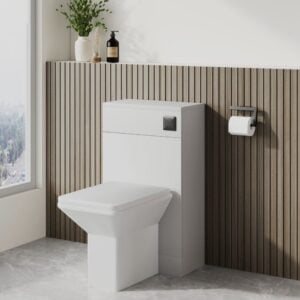
You can get away with a cistern on its own when the weight is handled some other way. That means a floor-standing or back-to-wall pan sitting on the floor, with the slim cistern hidden behind it in a stud wall, inside a WC unit, or recessed into a solid masonry wall. The pan stands on the floor, so nothing hangs, so you do not need the frame. That is the cheaper route, and on a solid wall it is often the sensible one.
How high it sits and how far it sticks out
Two numbers people forget until it is too late: how high the pan sits and how far the finished wall sticks out. Both come from the frame, so sort them before the plasterer arrives.
On a full frame the pan height is not fixed, it is set by you. The frame has an adjustable height, so you decide where the pan hangs and lock it before the wall goes on. Set it higher for a comfortable stand-up-and-sit-down, lower if it is a kids’ bathroom. The one rule is that you set it once, at first fix, because after the wall is tiled that height is baked in. Check the adjustable range on the frame you buy against the seat height you want before you commit.
How far it projects is about depth. The frame here is around 160mm deep front to back, and once you clad it in plasterboard and tile over the top the finished wall stands a bit more than that proud of the structural wall. So a wall hung setup on a frame eats a slice of floor depth along that run. A slim cistern on its own is shallower, roughly 155mm deep on the ones below, which is why the cistern-only route can suit a tight solid wall you are recessing into rather than building out from. Either way, measure the finished wall depth into your layout, because it is the thing that catches people out.
WRAS: what the approval means for a hidden cistern
You will see WRAS approved on the better cisterns, and it matters more here than on most fittings, because this one is going to be buried in your wall. Once the tiles are on, a leaking or failing cistern is a wall-out job, so the tank holding your mains water is exactly the part you do not want to cut a corner on.
Both of the standalone cisterns below are WRAS approved and moulded from strong, durable high-density polyethylene, with a 3 litre / 6 litre dual flush and a 2 year guarantee. In plain terms, WRAS approved is the tick you look for on a fitting that touches your drinking water, so it is the mark to search out on anything going inside a wall where you cannot easily get at it later. Buy the approval and the guarantee on a hidden cistern, and you are buying peace of mind as much as a tank. If you want the exact wording behind the approval for building control, confirm the current WRAS certificate on the product page before you buy, because approvals get renewed.
Cistern-only vs frame kit: side by side
Same job, two ways to buy it. This is what is in each box, what you still have to buy, and where each one suits.
| Cistern-only kit | Frame + cistern kit | |
|---|---|---|
| What is in the box | The slim concealed cistern, and a push button on some versions | The frame, the concealed cistern and a push plate |
| What you still buy | A floor-standing or back-to-wall pan, and a plate or button if not included | A wall hung pan and seat |
| Wall it suits | Solid wall you recess into, behind a WC unit, or a stud wall with the pan on the floor | Any wall: stud, dot-and-dab or solid, because the frame is self-supporting |
| Rough fitted height | Set by the pan, which stands on the floor at its own height | Set by you, on the adjustable frame, before the wall goes on |
| Price of the kits below | £39.99 for the bottom-inlet cistern | £189 for the rectangle-button frame kit |
One thing to get right whichever you buy: the push plate or button has to match the cistern. The plate triggers the flush valve inside that specific cistern, so a plate and cistern that were not built to go together may not line up or actuate properly. Buy the plate the cistern is designed for, or a kit where they come paired. Which button style suits which cistern, and how the pneumatic and cable types differ, is a whole checklist of its own, so see our guide to toilet flush buttons and plates and browse the push buttons and push plates range when you get to that stage.
Which concealed cistern and frame to buy: our BP picks
Pick by the fork at the top: full frame if a pan is hanging off the wall, cistern on its own if the pan stands on the floor. Here is where we would start.
- Cheapest cistern on its own: the Bathroom Point Concealed Cistern With Bottom Inlet, WRAS Approved at £39.99. A slim 415 x 340 x 155mm tank in durable high-density polyethylene, 3 litre / 6 litre dual flush, bottom inlet, WRAS approved, 2 year guarantee. Add your own plate and pan.
- Cistern with the button sorted: the Bathroom Point WRAS Approved Concealed Cistern And Chrome Push Button at £59.99. The same slim WRAS-approved cistern and dual flush, but with a matching square chrome push button in the box, so the plate is already paired to the cistern.
- Full frame with a rectangular plate: Wall Hung Toilet Frame And Cistern With Push Plate, Rectangle Buttons at £189. Frame, cistern and plate together, adjustable frame height, a high load capacity that supports up to 400kg, dual flush, a 5 year guarantee and a choice of plate finishes in chrome, matt black, brushed brass, gunmetal or brushed bronze.
- Round-button alternative: the Wall Hung Toilet Frame And Cistern With Push Plate, Round Buttons at £199. The same frame-plus-cistern idea with a round push plate, 160 x 550 x 1200mm, 3 litre / 6 litre dual flush, if round buttons suit your look better.
The full concealed cisterns and frames range has the rest. If you have not settled on the toilet itself yet, our choose a toilet guide runs through the pan types and our all about toilets guide covers how cisterns, pans and traps all fit together.
FAQ
What is a concealed cistern and frame?
It is the hidden half of a wall hung toilet. The concealed cistern is the flush tank that sits out of sight inside the wall, and the frame is the chassis that holds it and carries the pan. Bought together as a frame kit they give you the structure and the flush in one box, and you add the pan, the seat and the finished wall over the top.
Do concealed cisterns for wall hung toilets need a frame?
If the pan hangs off the wall, yes. The frame is what takes the weight, so a wall hung pan always needs one. Concealed cisterns for wall hung toilets are usually built into that frame anyway, so you buy them as a unit. You only skip the frame when the pan stands on the floor and the slim cistern just hides behind it.
What does a WRAS cistern mean and do I need one?
A WRAS cistern is one approved as fit to be plumbed into your mains water. On a cistern that is going to be sealed inside a wall it is well worth having, because you cannot easily get at it once the tiles are on, so you want the fittings holding that water to be up to standard. The Bathroom Point cisterns above are WRAS approved and come with a 2 year guarantee.
Sorting your cistern and frame
Get the first decision right and the rest falls into place: full frame if a pan is hanging off the wall, slim cistern on its own if the pan stands on the floor. Set the height on the frame before you board it, match the plate to the cistern, and look for the WRAS mark on anything going inside the wall. Start with the concealed cisterns and frames range, and if you are still on the wider setup our choose a toilet guide covers the pan.