Countertop Basins: Shapes, Sizes and What to Sit Them On
Bathrooms
A countertop basin is a bowl that sits on top of your worktop or vanity instead of dropping into it, so you see the whole thing and it adds its full height above the surface. That one fact drives every decision that follows: the shape you pick, what you stand it on, how tall the tap needs to be, and which waste it takes. Get those four right and it looks brilliant, but get the height wrong and you have got a sink you stoop over every morning.
- Countertop basin shapes and sizes
- What do you sit one on?
- The height maths (get this wrong and it is unusable)
- Taps: tall monobloc or wall-mounted
- Wastes and overflows
- Finishes: brass, black and white
- The cloakroom question
- FAQ
Countertop basin shapes and sizes
There are really four shapes worth talking about, and the difference is not just looks. Shape changes how much worktop you need, how easy the bowl is to wipe, and how well it holds a splash. Here is how they stack up, with a real example of each from the range.
| Shape | Example | Rough footprint | Best for | Splash and wipe-down |
|---|---|---|---|---|
| Round | KOKO Matt Black Fluted | 360mm across | Small vanities and tight worktops | Compact, so aim the tap dead centre or it splashes over the front |
| Rectangular | Litchfield 465mm | 465mm long | Modern, straight-edged schemes that sit tidy against a wall | Big wash area, but the corners collect toothpaste and need a wipe |
| Oval | Fluted oval bowl | 575 x 360mm | A softer look with a roomy bowl | No corners, so it wipes clean in one pass. Needs more worktop width |
| Vessel | Matt White LuXe | 615 x 360mm | A statement bowl with tall sides | Deep sides hold a splash well, but they push the rim height right up |
The short version: a 360mm round bowl fits almost anywhere and looks neat, but it is small, so a fast-running tap will throw water over the front lip. A rectangular basin like the Litchfield gives you a proper wash area and lines up cleanly against a wall, at the cost of corners you have to keep clean. Oval sits in the middle, no corners and a generous bowl, and it needs the most worktop of the lot. A tall vessel like the LuXe looks the part and contains water beautifully, but read the height section before you fall for one.
What do you sit one on?
This is the question people search for and never get a straight answer to, so here it is. A countertop basin needs a flat, solid surface at the right height with a hole drilled for the waste. You have three sensible options.
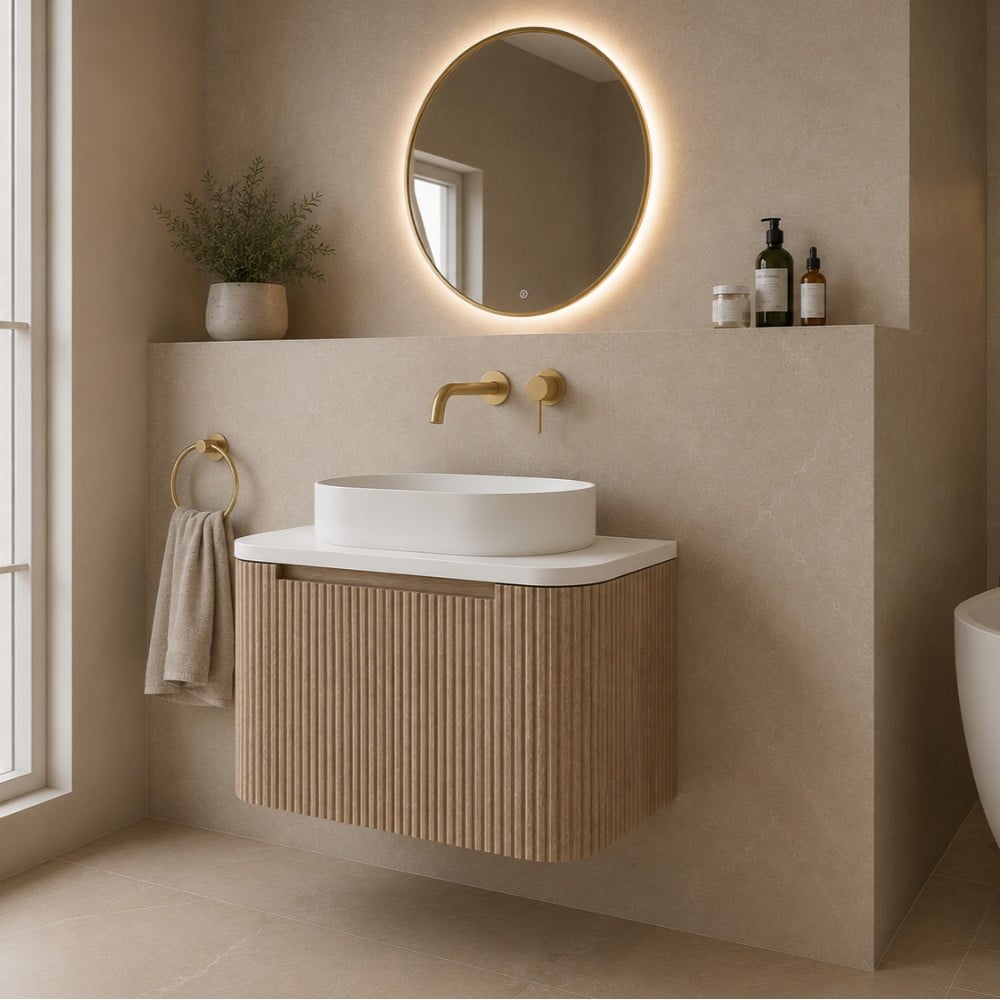
A vanity unit with a worktop. The cleanest route. You buy a unit designed to take a countertop bowl, meaning it has a solid top rather than a moulded ceramic basin built in, and you sit the bowl on it. Storage underneath, a run of worktop either side for your bits, done.
A vanity unit with no inset basin. Plenty of units come with a flat top ready for you to add your own bowl. This is the flexible option because you choose the basin separately, so you can match the shape and finish to the room rather than take whatever the unit came with. Just check the top is solid enough and that the waste hole lines up with where you want the bowl.
A standalone worktop or shelf. A slab of solid surface, timber or a made-to-measure top on brackets, with the bowl sat on top. This is the designer-bathroom look. It gives you total freedom on height, which is exactly why you have to do the maths in the next section, because nothing is fixed for you.
Whichever you pick, the rule is the same: solid top, correct height, waste hole in the right place. If you are shopping the countertop basins category, work out your surface first so you know the bowl footprint you are buying into.
The height maths (get this wrong and it is unusable)
Here is the mistake almost everyone makes. A normal vanity is built to hold an inset or semi-recessed basin, where the rim finishes roughly level with the top. A countertop bowl does not drop in. It sits fully on top, so it adds its whole height above the worktop.
The sum is simple:
Vanity or worktop height + bowl height = finished rim height.
That is the number your hands actually meet when you wash. So if you take a standard-height vanity that was designed for an inset basin and you plonk a tall vessel bowl on it, the rim ends up way too high and you are washing at chest level. It looks great in the showroom and it is a pain every single day.
Sort it before you buy. Measure the height of the unit or worktop, add the height of the bowl you fancy, and picture where the rim lands for the shortest person who will use it. A shallow round bowl adds far less than a tall vessel, so if your surface is already at a normal height, lean towards a lower bowl. If you are building a bespoke worktop on brackets, drop the worktop height to leave room for a taller bowl on top. The comfortable finished rim height is a matter of who uses the room, so dry-fit it and stand at the sink before you commit rather than chasing a single magic number.
Taps: tall monobloc or wall-mounted
A standard basin mixer is too short for a countertop bowl. The whole bowl sits above the worktop, so the tap has to clear the rim and reach far enough over it to land water near the middle of the bowl, not on the back edge. You have two ways to do that.
A tall monobloc basin tap. A high-rise mixer that mounts on the worktop behind the bowl and arches up and over the rim. This is the usual pairing and the easiest to plumb, because the feeds come up through the worktop like a normal tap. Match the tap height to your bowl height so the spout clears the rim with room to get your hands under it. Browse the tall basin taps and check the spout reach as well as the height.
A wall-mounted basin tap. The spout comes out of the wall above the bowl and pours straight down into it. It looks clean, frees up worktop, and it is brilliant with a bowl on a slim shelf. The catch is you have to plan it early, because the pipework goes in the wall before you tile. Get the projection right so the water lands in the bowl and not on the front rim. Have a look at the wall-mounted basin taps if you are still at first-fix.
Either way, the golden rule is spout reach over the bowl rim. If you want the full rundown on matching a tap to a basin, the sink tap buying guide walks through height, reach and pressure.
Wastes and overflows
This one trips people up because it is easy to buy the wrong waste. Most countertop bowls have no overflow, that little hole near the top of an inset basin that stops it flooding. Because the water has nowhere else to go, a countertop bowl without an overflow needs an unslotted waste. An unslotted waste has no side slot, so it seals the bottom of the bowl properly.
Fit a slotted waste to a bowl with no overflow and water can seep out through the slot. Fit an unslotted waste to a bowl that does have an overflow and the overflow cannot drain. So the rule is: match the waste to the bowl.
Now the search everyone types: an oval countertop basin with an overflow. Some bowls, oval ones included, do come with an overflow drilled in. If yours has one, you want a slotted waste so the overflow works. Check the bowl before you order the waste, because it is a five minute check that saves a leak. Most people go for a click-clack (push-button) waste on a countertop bowl since there is no room for a pop-up lever behind it.
Finishes: brass, black and white
Finish is where countertop basins earn their keep, because the whole bowl is on show. Two searches dominate here, black and brass, and the reason is simple: a countertop bowl is a feature, so people want it to stand out.
For black, the KOKO Matt Black Fluted bowl at £129 is the pick. It is a 360mm round bowl with a fluted, textured outside, a polymarble inner and a 304 stainless steel construction, so it wears the matt black finish well and holds its shape. Matt black looks smart against a pale worktop and it hides watermarks better than gloss.
Brass is the other big search. Warm metallics pair beautifully with a fluted bowl and brushed brass taps, and if that is your look, the trick is to tie the basin, tap and waste finishes together rather than mix three tones. There is a full breakdown of getting metal finishes to agree in bathroom tap finishes compared.
For white, which still sells more than anything, you have two honest workhorses. The Riviera 460mm at £99.99 is a rectangular gloss white ceramic bowl that keeps clean and suits almost any scheme. If you want a bigger statement in matt, the Matt White LuXe vessel at £149.99 is a 615 x 360mm vitreous china bowl in matt white. Just remember the height maths on that one, because whatever the bowl stands adds straight on top of your worktop height.
The cloakroom question
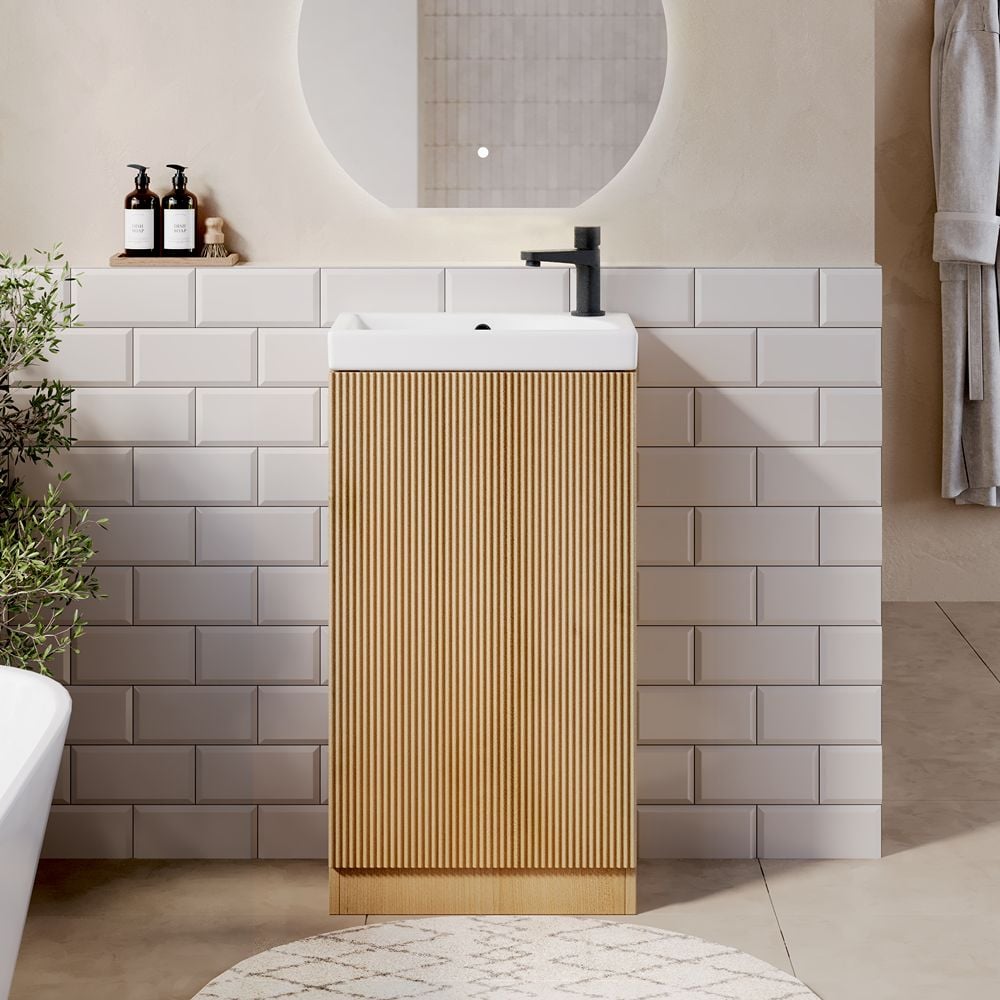
A small round bowl is the obvious pick for a tight space, and a 360mm round like the KOKO genuinely works in a cloakroom where a full-size basin would swallow the room. It sits on a slim vanity or a narrow shelf and leaves you space to actually stand.
The honest catch: a small bowl splashes more, not less. There is less water surface to catch the flow, so a tap running hard will throw water over the front lip and onto the floor. Two things fix it. Keep the tap central over the bowl and pick a spout that pours down rather than across, and go easy on the flow. In a cloakroom that gets a quick hand-wash rather than a full morning routine, a compact round bowl is spot on. If you want a step-by-step on a cloakroom countertop setup specifically, that is a job for a dedicated small-space guide rather than this one.
FAQ
What is a ceramic table top basin?
It is the same thing as a countertop basin: a ceramic bowl that sits on top of a worktop or vanity instead of being built into it. “Table top” and “countertop” get used interchangeably. Ceramic here usually means vitreous china, like the Litchfield and the LuXe, which is hard-wearing, easy to clean and holds a gloss or matt finish well.
What size worktop do I need for a bathroom sink?
Work back from the bowl. Measure the basin footprint, then leave a margin all round so the rim is not hanging over an edge, plus room behind for the tap if it is worktop-mounted. A 360mm round wants far less than a 615mm vessel. As a rule, a run of worktop that gives you a hand-span either side of the bowl feels right and gives you somewhere to put the soap. Confirm the depth of your unit takes the bowl before you order the top.
What is the best rectangular countertop basin in the UK?
For most bathrooms the Litchfield 465mm at £109 is the sensible rectangular pick: gloss white vitreous china, a compact 465mm length that fits a standard vanity, and clean modern lines. If you want something a touch narrower for a smaller top, the Riviera 460mm at £99.99 does the same job. Both sit tidy against a wall, which is the main reason people go rectangular over round.
Do countertop basins need a special tap?
Yes, effectively. A standard basin mixer is too short. You need a tall monobloc tap that clears and reaches over the bowl rim, or a wall-mounted tap that pours down into the bowl from above. Match the tap height and spout reach to your bowl height.
Do countertop basins have an overflow?
Most do not, which is why they usually take an unslotted waste. Some bowls do have an overflow drilled in, and those need a slotted waste so the overflow can drain. Check your specific bowl before you buy the waste.
Sort the surface, do the height sum, match the tap and waste to the bowl, then pick your shape and finish. Do it in that order and a countertop basin is one of the easiest wins in a bathroom. Start with the countertop basins range once you know your numbers.