Wet Room vs Walk-In Shower: UK Guide
Bathroom Ramblings, Bathrooms, Showers
People use “wet room” and “walk-in shower” as if they’re the same thing. They’re not, and the difference decides how much your bathroom costs and how disruptive the job is. A wet room is the whole floor: tanked, level access, no tray, water just runs to a drain. A walk-in shower is a wider doorless opening with a fixed glass panel sat on a shower tray, in an otherwise normal bathroom. One needs the floor ripping up and waterproofing. The other you can fit in a couple of days. Pick the wrong one and you’ll either overspend or end up with a leak in the ceiling below.
This guide covers what each one actually is, when to pick which, the glass panels and trays that do the job, how the drainage really works, and the bits people get wrong. There’s a comparison table and a cost breakdown if you just want the short version.
- Wet room vs walk-in shower: the actual difference
- When a wet room makes sense (and the glass to use)
- When a walk-in shower is the better call
- Shower trays for a walk-in: sizes and step-in height
- Drainage and tanking: the part that goes wrong
- What they cost to install
- Wet room vs walk-in: quick comparison
- Common mistakes to avoid
- FAQ
Wet Room vs Walk-In Shower: The Actual Difference
A wet room is a bathroom where the whole floor is waterproofed, or “tanked”. There’s no tray and no enclosure. The shower area is just a gently sloped section of tiled floor that falls to a drain, and the screen, if you fit one, is a single fixed glass panel. The entire room is built to be rained on.
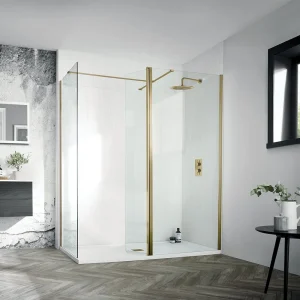
A walk-in shower is a normal shower area with no door. You get a fixed glass panel, or two, and a wide opening to step into. Underneath sits a shower tray with a low lip that keeps the water where it belongs. The rest of the room is built like any other bathroom, with no full tanking.
Both give you that open, frameless look that makes a bathroom feel bigger. The wet room takes it further by ditching the tray entirely. The walk-in is the more common choice in UK homes because it’s quicker, cheaper, and works in far more bathrooms without major building work. Here’s the honest version: most people who say they want a wet room actually want a walk-in shower. They want the look, not the floor-up rebuild.
When a Wet Room Makes Sense (And the Glass to Use)
Wet rooms earn their keep in two situations above all others: very small bathrooms, and anything accessibility-led. A handful of others too.
Tiny bathrooms and en-suites
If a tray and enclosure are eating half a small floor, a wet room hands that space back. No tray, no frame, just a single panel of glass. A cramped en-suite under about 3 square metres almost always feels bigger as a wet room. Counterintuitive, but true: removing the shower “box” is what opens the room up.
Step-free access
No tray means no step over. If anyone in the house has mobility issues, or you’re future-proofing for later, level access is the safer call. It’s exactly why care providers and new-build developers spec wet rooms in accessible bathrooms. A flat floor you can walk or wheel straight into beats a 40mm lip every time.
The glass: keep it to one panel
The whole point of a wet room is openness, so you want the least glass you can get away with. A single fixed screen does it. The Litchfield 8mm Black Wetroom Glass Panel at £149 (700mm wide) is the clean, low-cost way in. It’s 8mm toughened safety glass at a full 2000mm height, and it can be fitted directly onto a tiled wetroom floor or a tray using an adjustable wall channel that takes up the slack on walls that aren’t quite plumb. Old houses are never plumb, so that channel matters more than people expect.
The one worry with a bare panel in an open wet room is splash escaping past the end of the glass. If that’s nagging at you, look for the same panel with an integrated hinged flipper, a small deflector panel that swings in to contain water better while keeping the open look. It’s the sensible middle ground between a single bare screen and a full enclosure, and the one I’d point most people towards if the shower sits anywhere near a door or a towel rail.
What to bear in mind
The whole room gets tanked, not just the shower corner. That’s a waterproof membrane across the floor and up the lower walls before any tiles go on. Skip it or cheap out and water finds the joists, then the ceiling below. This is not a DIY job and not one for a general builder who’s never done a wet room. A good installer will guarantee the tanking in writing. If they won’t, walk away.
When a Walk-In Shower Is the Better Call
For most UK bathrooms, the walk-in is the smarter buy. You get the open, frameless look without the cost or the floor-up rebuild of a wet-room conversion.
Standard family bathrooms
If your floor already works and you’re refitting, a walk-in lets you upgrade without touching the subfloor. Set a low-profile tray, fit a glass panel, done. No tanking, no drainage redesign, a couple of days rather than a couple of weeks. The Litchfield 8mm Matte Black 2-Panel Walk-In Shower Enclosure Pack at £309 is the obvious starting point. It’s 8mm toughened glass with sleek matte black profiles in a two-panel, no-doors design built for open, accessible showering. Sit it on one of the trays below and you’ve got the walk-in look without going near a tanking membrane.
You want a shower and a bath
Wet rooms work best when the whole room is the shower. If you want a separate bath in the mix, a walk-in keeps the two zones clearly defined: shower contained, bath area dry. Trying to do both in an open wet room usually means the loo roll lives permanently damp.
Renting, or selling within a few years
A well-done wet room can add value, but a full conversion is overkill if you’re moving soon. A walk-in gives you most of the visual upgrade for a fraction of the cost and disruption.
If 8mm feels flimsy, frame it properly
Some people stand under a frameless 8mm screen, give it a wobble, and decide they want something more substantial. Fair enough. A fully framed walk-in enclosure is the answer: two 10mm glass panels at a full 2000mm height, wrapped in a full-perimeter frame, with around 20mm of adjustment per panel for those wonky walls again. It’s the architectural, fixed, reassuringly solid end of the range, and a brushed brass frame reads as a deliberate design choice rather than a builder’s default. If you like a warmer metal across the room, our brushed brass bathroom style guide covers pairing it with taps and fittings.
Shower Trays for a Walk-In: Sizes and Step-In Height
A walk-in lives or dies on the tray. Get the size and the step-in height right and it feels generous and safe. Get them wrong and you’ve either built a puddle or a trip hazard.
For a corner walk-in, a quadrant tray uses the space well because it tucks the curve into the corner and gives you the floor back. The Kstone 900 x 900 Anti Slip Quadrant Shower Tray at £249 is the one I’d reach for in a safety-led or accessible bathroom. It’s a 900 x 900mm quadrant with a genuine anti-slip surface and a low-profile design, and it works with common shower wastes, so you’re not hunting for an odd outlet size. The anti-slip surface is the bit that matters: a wet tile floor and a low step is fine until someone’s in a hurry.
If there’s room for a bigger footprint but you don’t want the full tanking job, a 1200 x 900mm offset quadrant gives you a more generous corner. The low-profile design reduces step-in height and it’s built for common shower wastes. One thing to get right at the order stage: an offset quadrant is sold left-hand or right-hand, so check which way your bathroom runs before you buy, because a left-hand tray in a right-hand corner is an expensive afternoon.
On step-in height, lower is better for nearly everyone. A low-profile tray gets you close to the level-access feel of a wet room without the membrane, which is the whole reason a tray is the practical compromise.
Drainage and Tanking: The Part That Goes Wrong
Drainage is where the wet room versus walk-in decision actually gets decided, and it’s the bit the showroom photos never mention.
The waste does the work
A shower is only as good as its waste. If the water can’t clear fast enough, it pools, and you’re standing ankle-deep wondering why you spent £500 on glass. For trays and wet room floors where flow matters, the McAlpine 90mm Chrome Plated Brass Grid Fast Flow Easy Clean Shower Waste at £44.99 is the higher-spec pick. It handles up to 50 litres a minute with just 15mm of head pressure, which exceeds the British standard requirement (BS EN 274-2). It fits 90mm shower tray outlets and connects to a 40mm waste pipe. That 50 L/min figure is the proof point: a big rain head pushing serious flow needs a waste that can keep up, and most can’t.
Wet rooms have a different problem: there’s often barely any depth under the floor to run a waste at all. That’s where a slimline waste comes in. The Wirquin Pro Slim 90mm High-Flow Shower Waste at £46.99 is a 90mm high-flow, low-profile waste made for exactly this: slimline trays, wet rooms and recessed shower bases where space under the floor is tight. If your installer is telling you there isn’t room for the drainage, this is the waste that often makes a wet room possible where a standard one wouldn’t fit.
The falls, and why a tray is easier
For a wet room, the floor has to fall towards the drain at roughly 1-in-60 so water actually goes where you want it. That gradient has to be built into the floor itself, which on a solid concrete floor can mean cutting a channel or building the whole floor up. A tray sidesteps all of that. The fall is already moulded into the tray, so you’re just connecting a waste.
The practical snag with a tray on a solid floor is finding room underneath for the waste pipe to run. That’s what pushes a lot of people towards a walk-in tray over a tanked floor in the first place. A shower tray riser pack solves it: the legs (typically in packs of 5 or 9, the 5-leg pack covering trays up to 1200mm) lift the tray off the floor so the waste pipe has somewhere to go, with a decorative fascia cover to hide the gap. This is the unglamorous fitting detail that decides whether a walk-in goes in cleanly or turns into a fight with the floor.
A word on tanking
Tanking is the waterproofing system under a wet room floor and lower walls: a membrane, sealed joints, and the right falls, all done before tiling. It is the single most important part of a wet room and the single most common thing to be skimped. We don’t stock tanking kits, so I won’t pretend otherwise. What I’ll say is this: it’s not a job to hand to a general builder who’s “sure it’ll be fine”, and the guarantee on the waterproofing should be in writing before any tiles go down. If that all sounds like more than you signed up for, that’s your nudge towards a tray and a walk-in.
What They Cost to Install
Costs vary by region, installer and bathroom size, but here are rough UK ballpark figures for the conversion work itself:
| Job | Typical cost (labour + materials, ex VAT) |
|---|---|
| Walk-in shower retrofit (tray, panel, fitting) | £800 to £1,800 |
| Wet room conversion (small en-suite, 2 to 3 sq m) | £2,500 to £4,500 |
| Wet room conversion (full bathroom, 4 to 6 sq m) | £4,000 to £8,000 |
These cover the conversion only, not new tiles, sanitaryware or decorative finishes. If you’re doing a full refit anyway, the extra to go wet room instead of walk-in is more like £1,000 to £2,500. Cheaper than people fear, but still real money, and most of it is buried in the tanking and the floor build-up you can’t see.
Wet Room vs Walk-In: Quick Comparison
The short version. Find your priority on the left and the answer falls out.
| Wet room | Walk-in shower | |
|---|---|---|
| Floor | Fully tanked, level access, no tray | Low-profile tray with a small lip |
| Glass | Single fixed panel (or none) | One or two panels, no door |
| Drainage | Drain set into the floor, slimline waste, built-in falls | Waste under the tray, fall moulded in |
| Best for | Tiny rooms, step-free access, design statement | Most family bathrooms, shower plus bath, selling soon |
| Install | Floor-up job, around 1 to 2 weeks | A couple of days |
| Typical conversion cost | £2,500 to £8,000 | £800 to £1,800 |
One takeaway: a wet room is a building project, a walk-in is a fit-out. If the words “tanking membrane” and “1-in-60 fall” make your eye twitch, you want a tray.
Common Mistakes to Avoid
- Cutting corners on tanking. The number one cause of wet room failure. The membrane has to cover the floor and the lower walls properly. Cheap waterproofing is a false economy that shows up as a stain on the ceiling below.
- Getting the drainage gradient wrong. The floor needs to fall to the drain by at least 1-in-60, or water pools and spreads. A drain at the edge of the shower is usually easier to gradient than one in the middle.
- Undersizing the waste. A big rain head and a slow waste means standing water. Match the waste to the flow, which is exactly why a high-flow waste rated to BS EN 274-2 is worth the extra few pounds.
- Forgetting the rest of the room. In a wet room the loo, basin and storage all share space with airborne water. Go for wall-hung furniture, water-resistant boards behind the tiles, and a proper extractor. Our guide on preventing humidity without a window is worth a read here.
- Skimping on the glass. A wobbly thin panel ruins the look. Go 8mm minimum, or 10mm framed if you want it to feel solid. Frameless looks cleaner but needs a proper fixing into something solid, not just plasterboard.
- No underfloor heating. Tiled floors are cold and stay wet. Underfloor heating dries the floor between showers, cuts the slip risk, and stops the room feeling like a fridge in January.
Frequently Asked Questions
Is a wet room the same as a walk-in shower?
No. A wet room has the whole floor tanked and waterproofed with no tray, draining straight to a floor waste. A walk-in shower has a low-profile tray and a fixed glass panel in an otherwise normal bathroom. The wet room is the bigger, pricier, more disruptive job.
Can you have a wet room in a small bathroom?
Yes, and they often work better in small bathrooms than walk-ins do. Removing the tray and enclosure and fitting a single glass panel makes a compact room feel noticeably bigger. A 700mm fixed panel is plenty for most en-suites.
Do wet rooms add value to a house?
A well-installed one can, especially in a master bathroom or an accessible bathroom. A badly installed one with leaks, poor drainage or a cheap finish does the opposite. The value is in the install quality, so pay for an installer who guarantees the tanking.
Are wet rooms prone to leaks?
Only if they’re tanked badly. Proper waterproofing with a quality membrane, correctly placed drainage and the right falls should give you a watertight room that lasts decades. Get the waterproofing guarantee in writing before any tiling starts.
What’s the minimum size for a walk-in shower?
Around 760mm wide is the comfortable minimum. 900mm to 1000mm is the sweet spot. A 900 x 900mm quadrant tray suits a corner nicely, while a 1200 x 900mm offset gives you a more generous footprint if the room allows.
What drain or waste do I need for a wet room?
A high-flow waste that can clear water faster than your shower delivers it, and ideally a slimline one because wet room floors rarely have much depth underneath. A 90mm high-flow waste is the usual answer. For a tray, a brass high-flow waste rated to BS EN 274-2 handles a powerful rain head without pooling.
Do I need a shower tray riser kit?
If you’re fitting a tray on a solid floor and the waste pipe needs room to run, yes. A riser pack lifts the tray off the floor to create that space and hides the gap with a fascia. On a timber floor with a void below you can often run the waste between the joists instead.
Do I need underfloor heating in a wet room?
Not technically, but it’s worth it. It dries the floor between uses, which cuts both slip risk and limescale, and stops the floor feeling cold underfoot. Electric mat systems are the easy retrofit, and they are the simplest way to take the chill off a tiled wet room floor.
Still weighing it up? Browse the full showers range to see panels, trays and wastes together. If low water pressure is also on your mind, our guide on choosing a shower when water pressure is low pairs well with this one. And if the whole project is a tight footprint, how to design a small bathroom is the one to read next. Want a second opinion on what’ll fit your actual room? Get in touch and the team will talk it through.