Shower Riser Rail Kits: Sizes, Fixings and Replacing One Without New Holes
Showers
A shower riser rail is the vertical bar fixed to the wall that holds your handset and lets it slide up and down, so a six-footer and a five-year-old can set the spray to their own height off the same shower. Buy it as a kit and you get the rail, the handset, the hose and the holder in one box, ready to hang on two brackets. The thing that actually stops people mid-order is not which one looks nice. It is whether the new rail will line up with the holes the old one left behind, and the honest answer is: pick a kit with adjustable brackets and it will.
Before you buy, clear up one bit of confusion. Three different products all get typed into Google as a “riser kit”, and they are not the same thing. Here is how to tell them apart, what is actually in a rail kit, how long a rail you need, how high to fit it, and how to swap one over without drilling fresh holes.
- Three different things get called a riser kit
- Will a new rail fit the old holes?
- What comes in a shower riser rail kit
- What length rail, and how high to fit it
- Matching the finish: black, brass or chrome
- FAQ
- Sorting your rail
Three different things get called a riser kit
Type “riser kit” into a search box and you will get three products back that do three different jobs. Get the right one in your head before you spend anything, because they are not interchangeable.
A sliding riser rail kit. This is the one most people mean, and the one this guide is about. A bar on the wall, a handset clipped to a bracket that slides up and down the bar, a hose and a holder. You move the handset by hand to whatever height suits, so it works for the whole household off one fixed feed. You will also see it called a shower slide rail or a slider rail. Same product, different name.
A rigid riser shower. This is a fixed vertical pipe plumbed up the wall, usually feeding an overhead fixed head and often a handset parked on a bracket lower down. It is a plumbed-in fixture, not a slide-up-and-down rail, so the head does not move. People go for the rigid riser look on traditional and exposed setups where the pipework is meant to be on show. If that is the direction you are leaning, our guide on concealed versus exposed showers is worth a read before you commit.
A shower tray riser kit. This one has nothing to do with the shower head at all. It is the legs and plinth that lift a shower tray up off the floor so the waste pipe has somewhere to run. Completely different part of the job, down at floor level. If that is what you are after you are in the wrong guide, but it is worth knowing the name exists so you do not order legs when you wanted a wall rail.
The rest of this is about the first one: the sliding riser rail kit. Browse the full range in the riser rails category and you are looking at that product.
Will a new rail fit the old holes?
This is the real question, and it is why so many people put off swapping a tired rail. Your old rail was drilled to its own bracket spacing. A new rail from a different maker almost never lands on the same two holes, so the fear is a wall full of filled patches and a fresh set of drilling into the tiles.
The fix is a kit with adjustable wall fixings. Instead of fixed brackets that force the rail to sit exactly where the maker decided, the brackets on these kits move, so you can slide them to sit over the holes you already have. The Middleton Chrome Shower Sliding Rail Kit with Adjustable Wall Fixings, £34.99, is built for exactly this. It is a chrome sliding rail kit with an adjustable-height shower head, the wall fixings are included, and the whole point of the adjustable fixings is that you are not tied to one bracket position. Line the brackets up with the old holes, mark, fix, done. No new drilling into the tile if the spacing is anywhere close.
A couple of practical bits. If the old holes sit a little proud of where the new brackets want to be, the adjustment usually pulls them into range, so measure the gap between your existing holes before you assume you are stuck. If a hole does end up on show, a smear of matched sealant or a small chrome cover cap tidies it, and you have avoided a full re-tile. And always fix into tile with the right plug and a slow start on the drill so the glaze does not skate. The rest of the riser rails range is worth a scan for adjustable-bracket options if the Middleton finish is not your thing.
What comes in a shower riser rail kit
A proper kit saves you buying four things separately. You get the rail itself, a handset, a flexible hose, and the sliding holder that clips the handset to the rail. That is the lot, ready to connect to the water feed already on the wall.
The handset is where kits differ. A basic single-spray head does one thing well; a multifunction head gives you a few spray patterns off the same handset. The Premium Chrome Shower Riser Rail Kit with 3-Mode Multifunction Shower Head at £29.99 is a good example: a chrome kit with a three-mode multifunction shower head and an adjustable rail so you set the handset height to suit, and it is built for easy, reliable installation. Three modes means you can switch the spray pattern at the handset without changing anything on the wall.
One thing to check with a multifunction head: it wants a bit of pressure behind it to make the modes feel different. If your water is gravity-fed off a loft tank and the flow is weak, read how to choose a shower when water pressure is low first, because a fancy head on feeble pressure just dribbles.
On the hose and handset, the connections on standard rail kits are a common size, so most handsets and hoses swap over between kits if you ever want to change one out. It is not a cast-iron guarantee across every brand on the market, so before you buy a replacement handset on its own, hold the fitting up against your hose and check the thread matches rather than assuming. Buying the parts as a matched kit sidesteps the whole question, which is the main reason kits are the easy route.
What length rail, and how high to fit it
There is no single right length, because the rail only needs to do one thing: let the handset slide from a low position to above the head of the tallest person who uses it. Work back from that. You want the bottom of the slide low enough to rinse feet, a dog or the tray down, and the top high enough that your tallest user can stand under it without stooping.
For a normal household a standard rail covers that range fine. Where you want an extra long shower riser rail is a tall household, a big walk-in where the rail sits further from where you stand, or anywhere you want the handset to park really high as a near-overhead spray. The extra length just buys you more travel top to bottom. Measure your wall space and the height of the tallest user before you pick, rather than guessing, because a rail that is too short for a tall user is the one thing you cannot fix later.
On mounting height, fit the top bracket so the tallest person can still reach up and lift the handset out of its holder comfortably, and set the bottom bracket so the rail clears the shower valve or bar tap below it and the hose does not kink at the bottom of its travel. Hold the rail on the wall and try the handset at the top and bottom before you mark a single hole.
If the shower is for someone less steady on their feet, a riser rail is not a grab rail and should never be leaned on as one. Grab rails and shower seats are separate fittings with their own mounting heights and fixing rules under the building regulations, so do not treat a handset rail as load-bearing support. Our guide to accessible showers, grab rails and shower seats covers the proper kit for that.
Matching the finish: black, brass or chrome
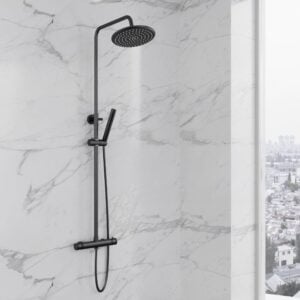
Chrome is the default and matches almost anything, which is why most kits come in it. But “black shower rail” is one of the most searched versions of this product for a reason: matt black has become the go-to on modern grey and white bathrooms, and a black rail against a light tile looks sharp. If that is your scheme, match the rail to the rest of your shower fittings rather than mixing metals, and browse the matt black showers range so the rail, valve and waste all pull together.
Going the other way, brushed brass and warmer metals suit period and heritage rooms. The brushed brass showers range keeps that consistent across the fittings. Whatever finish you pick, the rule is the same: decide the finish for the whole shower first, then buy the rail to match it, not the other way round.
For a classic look done properly, the Traditional Chrome Riser Rail Kit with Shower Head at £89.50 is a chrome kit with traditional styling, a height-adjustable handset position and the shower head included, aimed squarely at classic bathroom themes. It costs more than the modern chrome kits, and the traditional styling is what you are paying for. If you want the pipework and rail on show as a feature, the exposed showers range is where the rigid riser and period rail options live.
FAQ
Can I get a shower riser rail with adjustable brackets?
Yes, and it is the one to buy if you are replacing an old rail. Adjustable brackets, sometimes sold as adjustable wall fixings, let you slide the fixing points to sit over your existing holes instead of drilling fresh ones. The Middleton Chrome Shower Sliding Rail Kit at £34.99 is built around exactly that, with the wall fixings included. Measure the gap between your old holes first, then check the kit’s adjustment covers it.
What is an extra long shower riser rail?
It is a rail with more length than a standard one, which gives the handset more travel from top to bottom. You want one for a tall household, a large walk-in where the rail sits away from where you stand, or when you want to park the handset really high as an almost-overhead spray. For an average-height family a standard rail covers the range fine, so pay for the extra length only if you actually need the reach.
What is a curved shower riser rail?
A curved rail bows out from the wall rather than running dead straight, which suits some enclosures and setups where a straight rail would foul a tap or a glass panel. It works exactly the same as a straight one, with the handset sliding along the bar; the curve is about clearance and looks rather than function. If your straight rail keeps clashing with the valve or the screen, a curved one can solve it.
Is a shower slide rail the same as a shower riser rail?
Yes. Shower slide rail, slider rail and sliding riser rail all describe the same product: a wall bar with a handset that slides up and down it. Do not confuse it with a rigid riser, which is a fixed plumbed-in pipe where the head does not move, or a shower tray riser kit, which is the legs that lift a tray off the floor. Three different products, three different jobs.
What is the difference between a riser rail and a rigid riser?
A riser rail has a handset that slides up and down a bar, so anyone can set their own height by hand. A rigid riser is a fixed vertical pipe, usually feeding an overhead fixed head and a parked handset, and nothing on it moves up or down. Riser rails suit most modern showers; rigid risers suit traditional and exposed setups where the pipework is part of the look.
Sorting your rail
Work out which of the three riser products you actually want, and if it is the sliding wall rail, go for a kit with adjustable brackets so you can reuse your old holes and skip the drilling. Match the finish to the rest of your shower, pick the length off the height of your tallest user, and hang the top bracket where they can reach the handset without stooping. Start in the riser rails category to match a kit to your bathroom, and if you are still choosing between an exposed and a concealed setup, read concealed versus exposed showers first.