How to Stop Condensation on a Bathroom Mirror
Mirrors
Your mirror fogs up because warm, damp air from the shower hits the cold glass and the moisture turns straight back into water on the surface. Stop the two from meeting and you stop the fog. The quick fixes are better ventilation, warming the room, and the odd anti-fog trick. The permanent fix is a mirror with a built-in demister pad that gently warms the glass so steam never settles on it.
This guide explains the physics in plain English, runs through the cheap tricks that actually work, and shows you where a demister mirror earns its keep. There’s a quick comparison of the fog-free options near the end if you just want the short version.
- Why your bathroom mirror fogs up
- Quick ways to stop condensation on your mirror
- Anti-fog tricks: do they work?
- Demister mirrors: the proper fix
- Fog-free mirror cabinets
- Which fog-free mirror should you choose?
- FAQ
Why Your Bathroom Mirror Fogs Up
It’s condensation, and it’s the same thing that happens to a cold drink on a hot day. A hot shower fills the room with warm air carrying a load of water vapour. When that warm, moisture-heavy air touches a colder surface, the glass of your mirror being the obvious one, it cools down fast and can no longer hold all that water. The vapour turns back into tiny droplets on the surface, and you’ve got a fogged-up mirror right when you need it most.
Two things make it worse. The first is a big temperature gap between the steamy air and the cold glass, which is why mirrors fog hardest in winter and in unheated bathrooms. The second is a room with nowhere for the damp air to go, so it builds up and clings to every cold surface it can find.
So there are really only three ways to win. Cut the amount of moisture in the air, narrow the temperature gap by warming the glass, or keep the steam off the surface in the first place. Everything below is a version of one of those three.
Quick Ways to Stop Condensation on Your Mirror
Before you buy anything, work through the free fixes. A surprising number of fogging problems come down to a room that can’t shift its own moisture.
- Run the extractor fan, and leave it running. Switch it on before you shower, not after, and give it a good ten to fifteen minutes once you’re out. A fan that clicks off the second you flick the light is doing half a job. If yours is feeble or non-existent, it’s worth sorting, and our guide to preventing humidity in a bathroom without a window covers the options.
- Crack a window. Even a small gap gives the damp air somewhere to escape instead of settling on the glass. Free, and it works.
- Warm the room first. Narrowing the gap between the air and the glass is half the battle. A warm bathroom fogs far less than a cold one, which is one more reason a heated towel rail or radiator earns its place. Our guide to keeping your bathroom warm goes into the heating side properly.
- Drop the shower temperature a notch. Scalding showers produce the most steam. A slightly cooler shower puts less moisture into the air, and your skin will thank you too.
- Leave the door open afterwards. Trapped steam has to condense somewhere. Give it a way out and your mirror clears far quicker.
Do all of these and a mild fogging problem often disappears. If your mirror still steams up like the inside of a kettle every morning, the room is throwing more moisture at the glass than ventilation alone can handle, and you’ll want a mirror that fights back.
Anti-Fog Tricks: Do They Work?
The internet is full of home remedies for a steam-free mirror. Some genuinely help, some are a waste of a perfectly good bar of soap. Here’s the honest version.
- Soap or shaving foam rubbed on the glass. Smear a thin layer over the mirror and buff it off with a dry cloth. It leaves a film that stops droplets forming. It does work, but only for a day or two, and you’ll be redoing it constantly. Fine in a pinch, tedious as a routine.
- Washing-up liquid. Same idea, same surfactant film, same short lifespan. A streaky compromise at best.
- Commercial anti-fog sprays. The ones sold for car windscreens and swimming goggles last longer than soap and are less messy. A reasonable stopgap, though you’re still reapplying every week or so.
- A hairdryer. Blasting the fog off works for thirty seconds, then it’s back. It treats the symptom, not the cause, and it’s a faff at 6am.
The catch with all of these is that they’re chores. They fight the symptom over and over instead of removing the cause. If you want a mirror that’s just clear, every single morning, with nothing to remember and nothing to wipe, you want the glass itself kept warm. That’s what a demister mirror does.
Demister Mirrors: The Proper Fix
A demister mirror has a thin heated pad bonded to the back of the glass. Wired into your bathroom lighting circuit, it warms the surface just enough that the glass never drops below the temperature at which steam condenses. No cold surface, no fog. It’s the same principle as a heated car rear window, and it’s the only fix on this list that’s genuinely set-and-forget.
Most demister mirrors are LED mirrors too, so you get even, shadow-free light for shaving or make-up along with the fog-free glass. The good ones are properly built for a bathroom: look for an IP44 splash-proof rating as a minimum, and ideally a touch or sensor switch so you’re not jabbing at a wet button. A quick run through the options that earn their money:
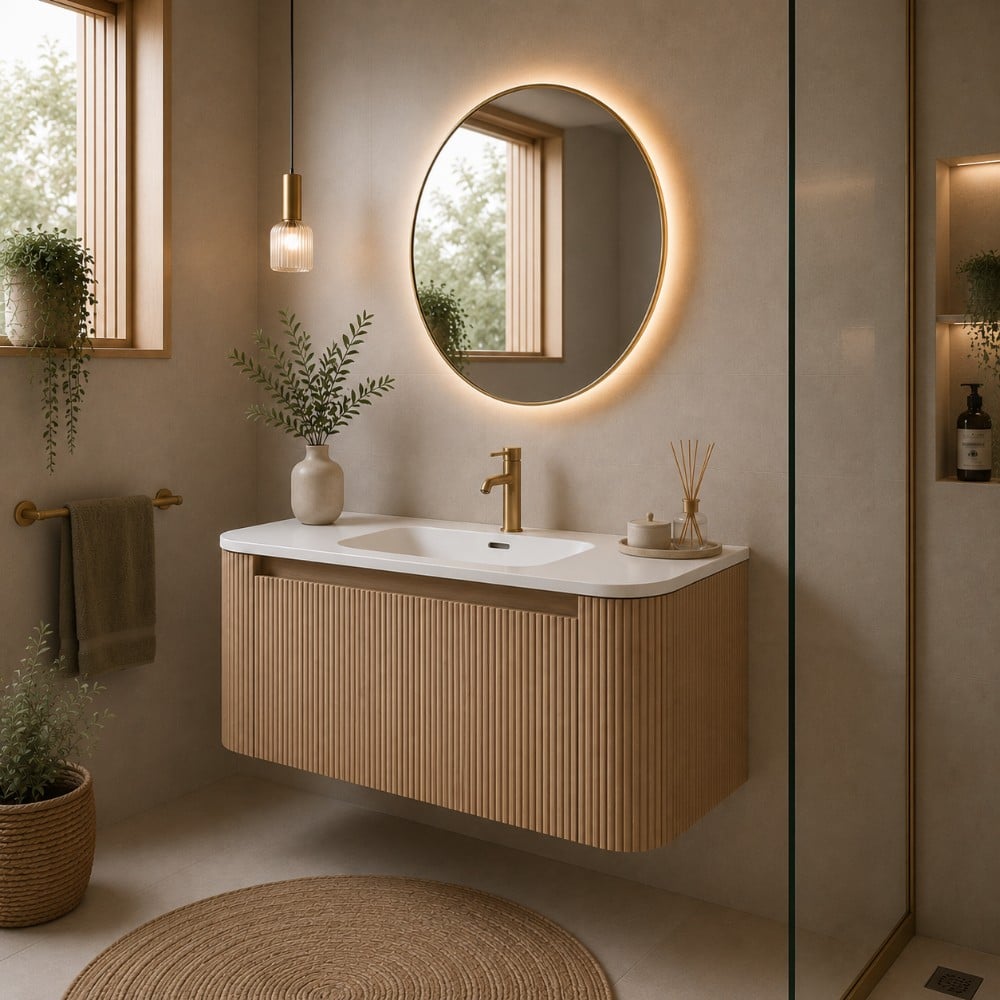
- If you want a large statement piece, the Alba LED Mirror 800 x 746mm is the one to beat. It’s a semi-circular touch-sensor design with an integrated demister pad that, in the maker’s words, keeps it “fog-free even in steam-filled bathrooms”, built on film-backed safety glass with an IP44 rating. It’s £329, which is a lot of mirror for the money.
- For a framed look, the Aubrey LED Mirror 500 x 800mm in matt black pairs a built-in demister pad with a simple touch sensor, so it “stays clear even after hot showers”. It’s £209. Prefer a warmer metal? The same mirror comes as the Aubrey Gunmetal Edged 500 x 800mm with an integrated demister for “a crystal-clear reflection even in the steamiest of bathroom environments”, at £209.
- Over a wide vanity or a double basin, a single big mirror beats two small ones. The Mosca LED Mirror 1200 x 600mm spans the lot, comes with a shaver socket, mounts landscape or portrait, and its demister pad keeps it “free of steam and condensation after showers”. It’s £379.
- Anti-fog tech isn’t limited to plain rectangles. If you want something with a bit of character, the Passa Hexagonal LED Mirror 800mm in matt black has the demister pad and contactless sensor controls with a memory function that remembers your last light setting, at £279. For a softer round shape, the Macie Round Framed Mirror 600mm adds colour-change lighting so you can flip between cool and warm tones, at £199. The frameless Jacob Teardrop LED Mirror is the showpiece option, with a backlit glow and a demister pad to prevent condensation, at £199.
One thing worth knowing: people search for an “anti-fog mirror” and a “demister mirror” as if they’re different things. They’re the same idea. The only mirror in the range that uses the exact phrase “anti-fog technology” is the Martha Matt Black LED Touch Mirror, a tidy entry-price pick at £159 with a built-in demister pad, vertical or horizontal mounting, and a two-year guarantee. If you want the whole range in one place, the fog-free mirrors category collects them all.
Fog-Free Mirror Cabinets
If you’re short on storage as well as patience, a demister mirror cabinet does both jobs at once. You get the heated, fog-free door plus a cupboard behind it for the clutter that otherwise lives on the windowsill. For a small bathroom especially, it’s the most space-efficient way to buy a mirror.
The LED Mirror Cabinet 600 x 700mm is the workhorse here at £319. It’s got a built-in demister pad that “keeps your mirror clear after every shower”, hands-free infrared sensor lighting, a shaver socket, soft-close double doors, two adjustable glass shelves, and an IP44 rating. That’s pretty much the full spec sheet in one unit.
Want the lot, tech and all? The Prosper LED Mirror Cabinet 500 x 700mm adds Bluetooth speakers, a shaver socket and adjustable glass shelves on top of the demister pad and infrared sensor lighting, for £329. If you’re weighing up a cabinet versus a plain mirror, our illuminated mirror cabinet buying guide walks through sizing, lighting and the rest.
Which Fog-Free Mirror Should You Choose?
Here’s the short version. Match what you’re after on the left and the pick falls out.
| You want | Best pick | Price |
|---|---|---|
| A big statement mirror | Alba LED 800 x 746mm | £329 |
| A framed look | Aubrey 500 x 800mm (matt black or gunmetal) | £209 |
| Wide cover over a double basin | Mosca LED 1200 x 600mm | £379 |
| A design-led shape | Passa Hexagonal or Jacob Teardrop | From £199 |
| Fog-free plus storage | LED Mirror Cabinet 600 x 700mm | £319 |
| The cheapest way in | Macie Round 600mm or Aubrey matt black | £199 |
Whatever you pick, get a demister mirror wired into the lighting circuit by a qualified electrician. It’s bathroom-zone wiring, so it’s a job for someone who knows the regs, not a Saturday afternoon with a screwdriver. The full illuminated mirrors range and the mirror cabinets range are worth a browse for sizing and finish options.
Frequently Asked Questions
How do I stop my bathroom mirror from fogging up?
Stop the warm steam from settling on cold glass. Ventilate well by running the extractor fan during and after your shower, warm the room so the mirror isn’t a cold surface, and crack a window. For a permanent, no-effort fix, fit a mirror with a built-in demister pad, which warms the glass so steam never condenses on it.
What is a demister mirror and how does it work?
A demister mirror has a thin heated pad bonded to the back of the glass. When it’s switched on it gently warms the surface, keeping it above the temperature at which steam turns to water. Because the glass is never cold, condensation can’t form, so the mirror stays clear even straight after a hot shower.
Is a demister mirror the same as an anti-fog mirror?
Yes. “Demister mirror”, “anti-fog mirror”, “fog-free mirror” and “steam-free mirror” all describe the same thing: a mirror with a heated pad that keeps the glass clear. The wording just varies between brands and listings, so don’t read anything into it.
Do demister mirrors use a lot of electricity?
No. The demister pad draws very little power, similar to a low-wattage panel, and it’s only on while the mirror light is on, which is usually a few minutes at a time. The running cost is negligible compared with the convenience of a mirror that’s always clear.
Can you add a demister pad to an existing mirror?
Aftermarket demister pads do exist, and they stick to the back of a mirror and wire into the lighting circuit. In practice it’s fiddly and the results can be patchy, especially if you can’t get even contact across the glass. For a reliable result, a mirror with the pad built in and tested is the safer bet, and it should be wired in by a qualified electrician either way.
Will an anti-fog spray work as well as a demister mirror?
An anti-fog spray leaves a film that stops droplets forming, and it does work, but only for a week or so before you reapply. A demister mirror keeps the glass clear permanently with nothing to remember and nothing to wipe. Sprays are a fine stopgap; a demister mirror is the actual fix.
Sorting your mirror as part of a bigger bathroom project? Browse the full fog-free mirrors range at Bathroom Point. If condensation is a problem across the whole room, our guide to preventing humidity without a window tackles the damp at source, and keeping your bathroom warm helps narrow that all-important temperature gap. A warm, well-ventilated bathroom with a demister mirror is one you’ll never have to wipe down again.